

Andy Zenkevich is the Founder and CEO of Epiic, a hospitality marketing agency helping boutique hotels and experiential stays grow direct bookings through data-driven marketing, SEO, content, and operational strategy.
Let me ask you something direct and uncomfortable.
Are you pouring money into your hotel website, yet you continue watching OTAs take away your bookings?
OTAs got 61% of all bookings for independent properties in 2024. That’s more than half of your rooms going through a middleman who takes a cut of every single one.
Not because guests prefer them. But because when someone looks up a property like yours, your website doesn’t show up. Theirs does.
I’ve worked with hospitality businesses across the board. And here’s the pattern I’ve seen: Great property. Great guest experience. Weak website SEO.
Most hotel operators don’t write their website copy the way travelers actually search. Travelers don’t type “hotel.” They type “boutique hotel near the French Quarter” or “family hotel with pool in Miami Beach.” If your pages aren’t built around how real guests search, you’re invisible to the people who are most ready to book.
On-page SEO for hotel websites is how you close that gap.
In this guide, I’ll walk you through what to fix.
Key takeaways:
- On-page SEO for hotel websites targets how travelers actually search: location-first, intent-driven, and largely on mobile.
- Title tags and meta descriptions determine whether travelers click your listing or a competitor’s.
- High-quality, specific content keeps travelers on your site longer and signals relevance to Google.
- Local SEO signals, including consistent NAP (name, address, and phone number), embedded maps, and structured data, help your property rank where it matters most.
- Page speed and mobile performance are ranking factors and are therefore a must.
Key elements of on-page SEO for hotel websites
Successful on-page SEO for hotel websites means getting several things right at the same time. It’s much more than just tweaking a few words on your homepage.
It involves:
- Keyword research
- Metadata optimization
- Content strategy
- Heading structure
- Image SEO
- Internal linking
- Local signals
- Technical performance
Each aspect affects your hotel’s ranking and visibility: at the top of search results or buried on page three.
Here’s how to approach each one.
your website should be winning
I run epiic.com, a hospitality marketing agency that works with hotels, resorts, and experiential stays to grow direct bookings through SEO and content.
If you want to know exactly what is holding your website back,
our team will audit it at no cost.
1. Research keywords the way travelers actually search
The first step in a strong on-page SEO strategy is understanding your potential guests’ search behavior.
The more specific the search, the closer the traveler is to booking. “Boutique hotel in Chicago” or “pet-friendly hotel near Central Park” is not the same as “hotel.” That extra detail is everything. It tells you exactly what they want and how close they are to booking.
These are called long-tail keywords, which make up most of the Google searches. For hotels, they almost always include a location or a specific amenity. That’s your competitive edge over larger chains burning budget chasing broad terms.
Short vs long-tail keywords
| Keyword type | Example | Intent |
|---|---|---|
| Generic | hotel | low |
| Mid-tail | hotel in Miami | medium |
| Long-tail | family hotel with pool Miami Beach | high |
Once you have the right travel keywords, use them like this:
- Your title and H1 should match the topic and the guest’s intent (aka primary keyword).
- Include related terms and phrases that surround your main keyword in your section headers (aka supporting os LSI keywords).
- Sprinkle related words, locations, and contextual details naturally throughout your page content (aka entities and semantic signals).
A focused set of location-specific keywords outperform a page filled with loosely related terms.
2. Optimize your title tags and meta descriptions for more clicks
These two seemingly trivial fields are doing much more than most hotel operators realize.
Your title tag is the clickable headline people see in Google. Your meta description is the two lines of text underneath it. The title tag and meta description are part of a search snippet. Together, they decide whether someone clicks your link or the one below it. That’s it. That’s their entire job.
And when OTAs are sitting right above you in search results, getting this right is not optional.
Title tags should be up to 60 characters long (or approximately 600 pixels). And they should include your location, hotel name, and main keyword. Something like: Luxury boutique hotel in Tribeca, New York | Stylish loft suites.
Clear, specific, and useful to someone scanning results on their phone.
Good vs. bad title
| Good | Bad |
|---|---|
| Boutique hotel in Miami Beach with ocean view | Hotel Miami |
Meta descriptions should be 120 to 160 characters (or up to 920 pixels). Use them well. Lead with your strongest selling point. Is it the pool, the view, or how close you are to the beach? You decide.
Write for your guest, not for Google. Think about who actually stays at your hotel and what they need to hear to feel, “Yes, that is the one.” Lead with that.
Here’s an example for a family-friendly beach hotel: Spacious family rooms, a kids’ pool, and direct beach access in Santa Monica. Everything your family needs for a perfect beach holiday, two blocks from the ocean.
Strong metadata helps earn you the click even before the traveler gets to your page. Weak metadata hands that click to your competition.
3. Create content that helps travelers picture the stay
Let’s face it, hotel content can be boring.
“Comfortable rooms. Excellent service. Ideal location.” Yawn.
Every hotel essentially says the same thing. And Google, along with AI tools like ChatGPT and Perplexity, ranks pages based on relevance and usefulness to the person searching. Generic descriptions fail that test.
Dig deep. What does your guest actually need to know? What does the room look like? What’s within walking distance? Where do locals eat? The more questions your page answers, the longer a traveler stays on your site, and the more Google trusts it.
I’m a huge supporter in adding local travel content directly to hotel pages. Nearby restaurants, transport links, weekend tips. All of it helps.
Write for the traveler who’s deciding. Can they picture waking up in that room? Can they see themselves walking to dinner from your front door?
If the answer is no, the content isn’t doing its job.
4. Use a clean heading structure so Google understands your pages
You don’t use proper headings just because they make a page look good. Headings sort of serve as the table of contents for your page.
Here are some things to remember:
- Every page should have one H1. That’s your main title, and it should have your primary keyword.
- H2s break the page into sections.
- H3s go deeper into the detail within those sections.
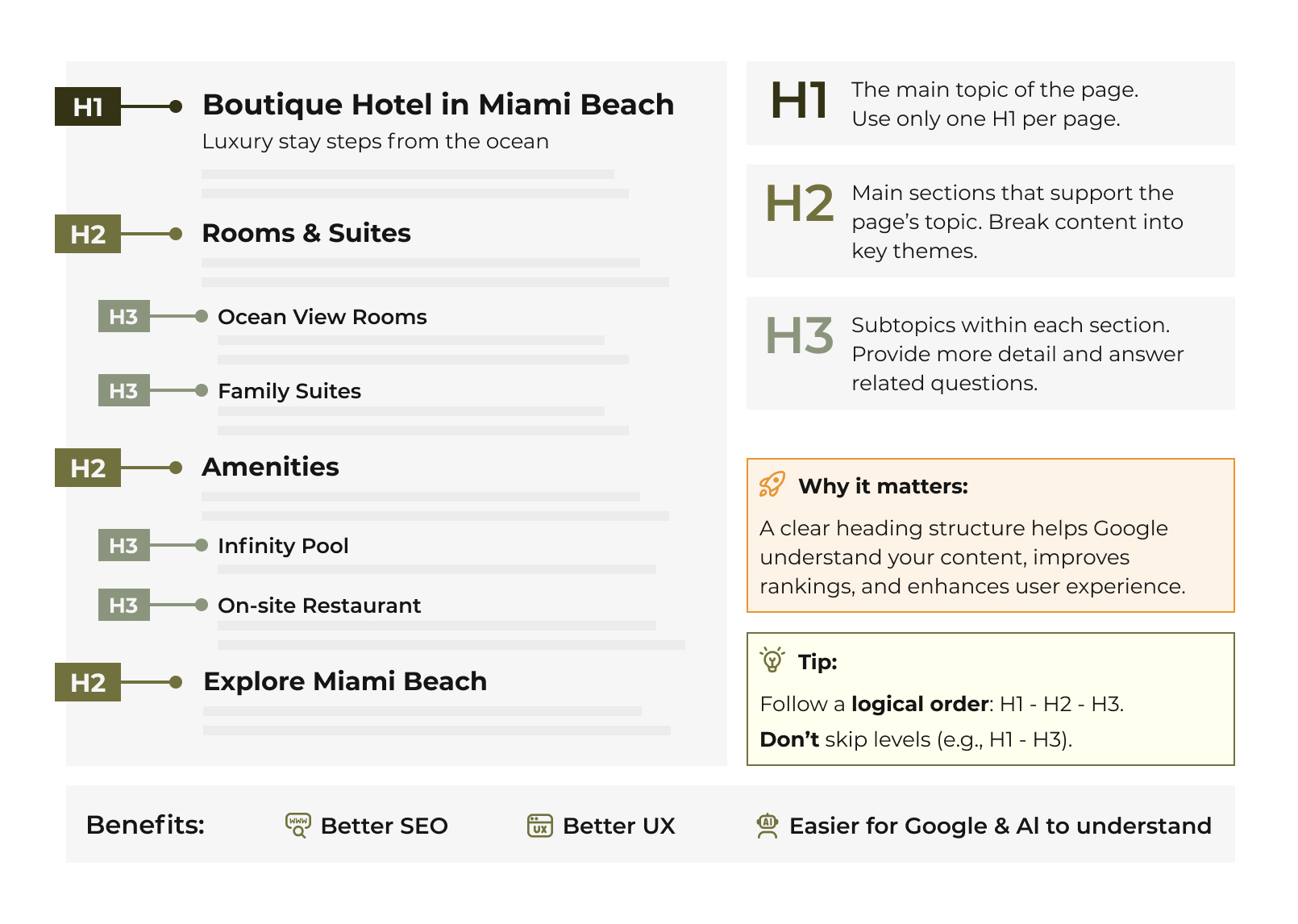
A clean heading structure does two things at once. It tells Google what your page is about before it reads a single word of your content. And it makes it easier for real visitors to scan your page. This is important, as most people scan before they commit to reading.
One more tip: work keywords into your headings organically. If a heading sounds like it was written for an algorithm rather than a person, rewrite it.
5. Optimize every image
Your hotel lives and dies by its photos. Great images sell the stay. The thing is, most hotel sites are sitting on a library of beautiful shots that are doing absolutely nothing for their SEO.
The fix is simpler than you think.
The problem: A file named IMG_003.jpg doesn’t tell the search engine anything.
The solution? Rename it to beachfront-hotel-room-clearwater.jpg and it immediately starts working for you.
That’s a 10-second change with a real long-term upside.
Next, add alt text to every image.
Alt text is a short written description search engines read. Remember, they can’t actually see your photos. So write your alt text as a plain, accurate description, such as “Luxury ocean view suite at Myrtle Beach hotel.” Not a string of keywords. Just a clear description. It helps visually impaired visitors and boosts your image search rankings at the same time.
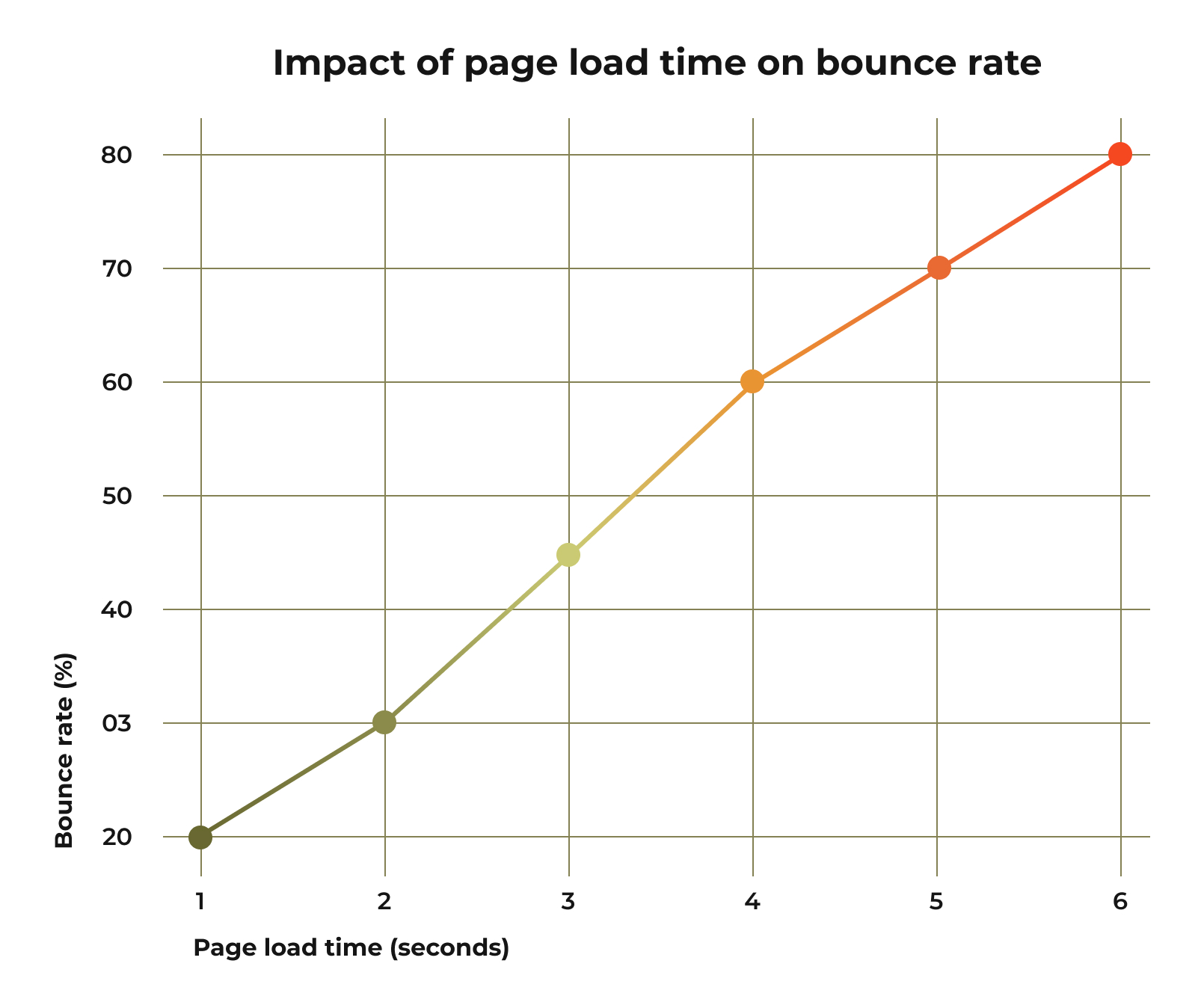
Last, compress every image before uploading. According to Google, pages that load within 2 seconds see significantly lower bounce rates. Large image files are one of the fastest ways to undo every other SEO improvement you’ve made.
6. Build internal links that distribute your SEO authority
Internal linking sounds technical. Yet it’s one of the simplest on-page SEO recommendations for hotel websites, and one of the most consistently ignored.
Think of internal links this way: Your website is a city, and your homepage is the main square. Your rooms page, booking page, and blog posts are the streets and neighborhoods. Internal links are the road signs that connect everything together.
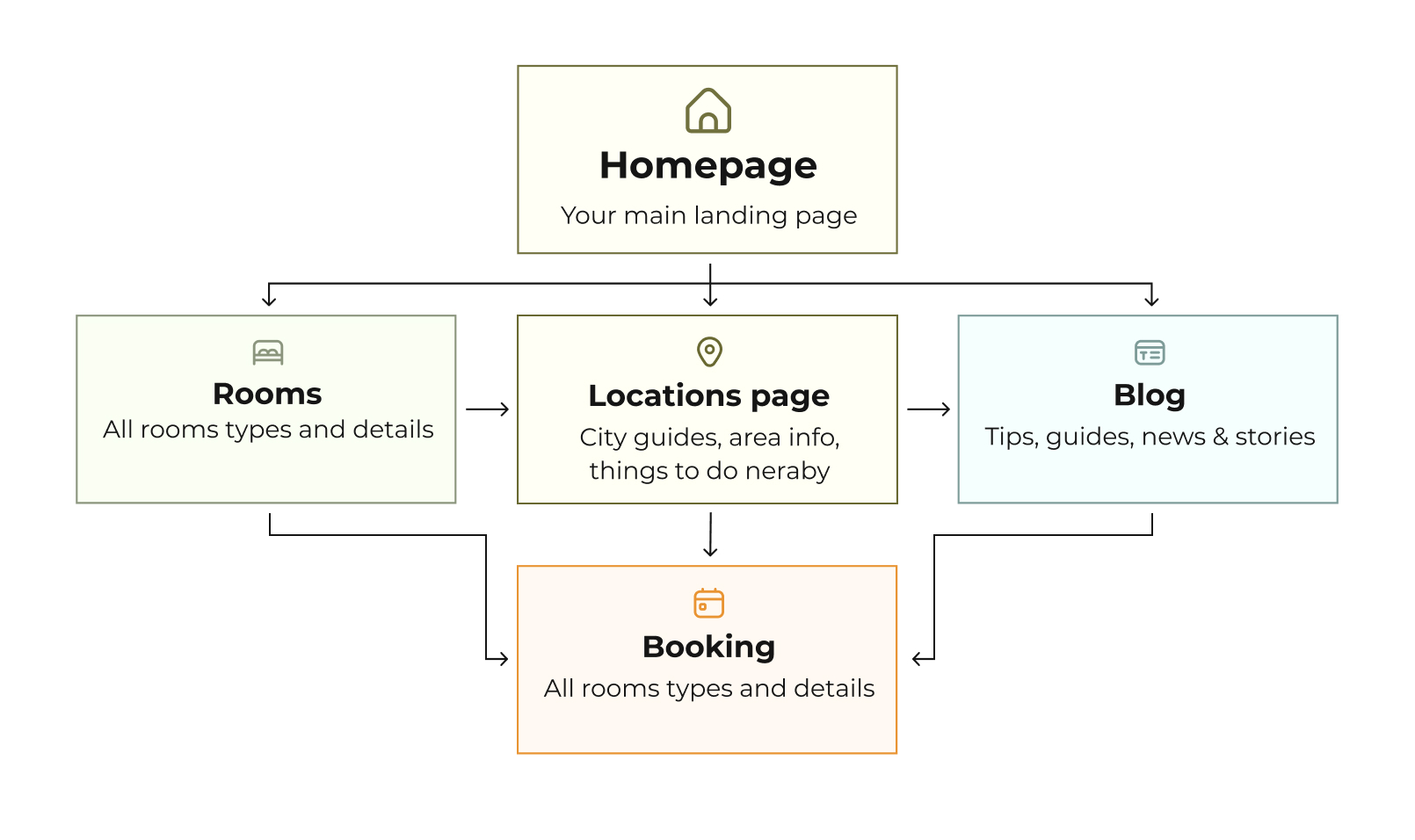
Here’s a practical example.
A blog post about the top 10 things to do near your property can pass real SEO value to your rooms and booking pages just by linking to them.
That’s free ranking power you’re leaving on the table if your pages don’t link to each other.
Your site is a network. It’s not a collection of stand-alone pages. The more you connect them, the stronger the whole thing gets.
7. Add local SEO signals to every hotel page
Local optimization is a critical component of on-page SEO services for hotel websites. And it’s where many independent properties fall short.
Your guests search for properties in a specific city, neighborhood, or near a specific landmark. Your pages need to speak that language directly.
Now here’s the part most people get wrong. Your NAP (name, address, and phone number) must be identical everywhere your property appears online. Your website, Google Business Profile, TripAdvisor, OTA listings. All of them. Even a small inconsistency can confuse Google and cost you rankings.
One more thing worth doing. Add structured data markup to your pages using schema.org.
Sorry, too technical, I know.
But you can think of it as a translation layer between your website and Google. It tells Google exactly what your page contains (room types, price range, amenities, check-in times, etc.). All in a format Google can read instantly.
Most hotels haven’t done this yet. Do it now and you have an edge.
8. Build E-E-A-T signals into every page
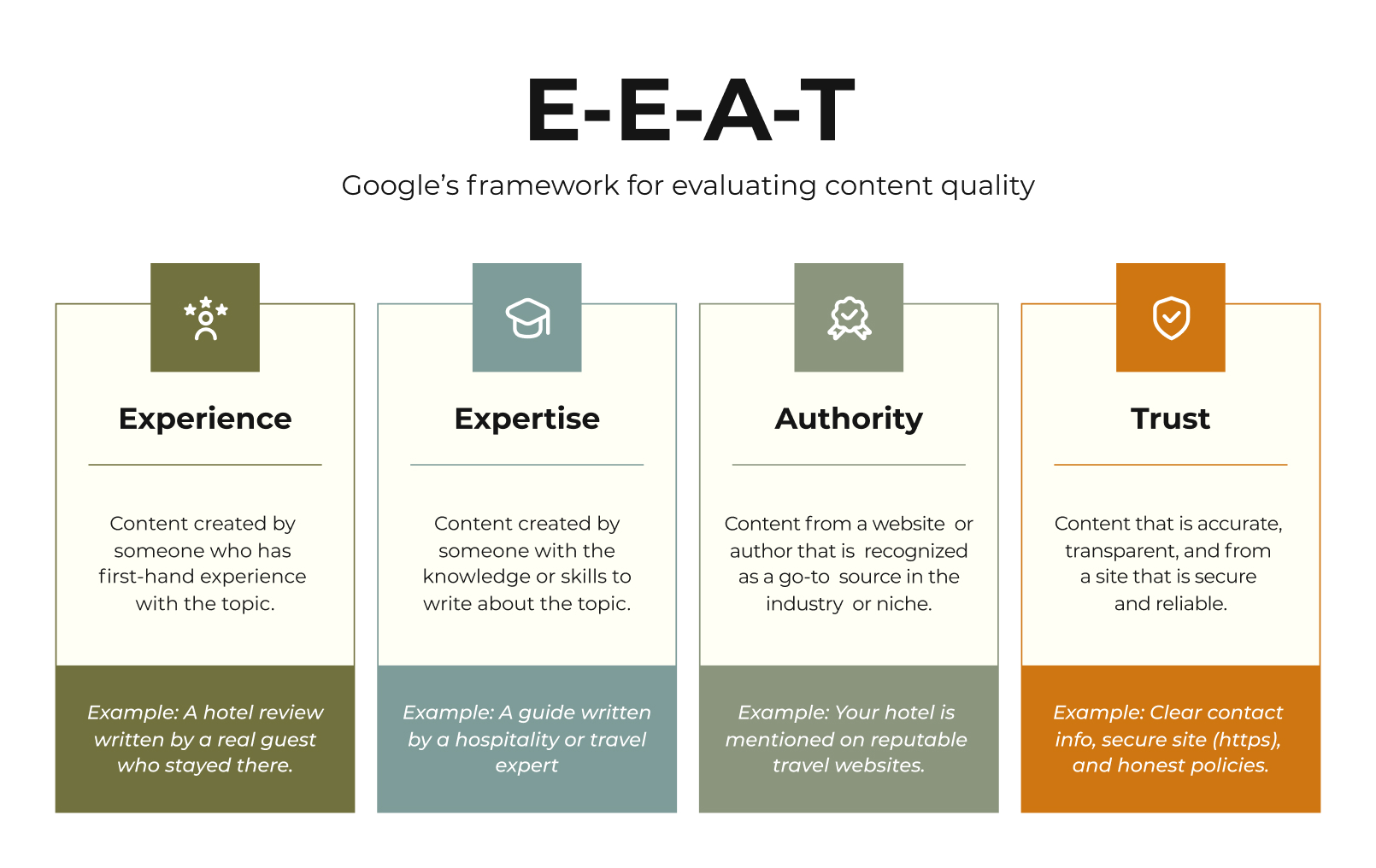
Google doesn’t just read your pages. It does something far more important, that is, figuring out if you can be trusted.
That’s where E-E-A-T comes into the picture. It stands for Experience, Expertise, Authoritativeness, and Trustworthiness. It’s the framework Google uses to assess content quality. And for hotels, it’s essential.
Why?
Your guest’s perspective. They’re planning a trip based on what they read on your website. Google makes sure that what they find there is accurate, genuine, and written by someone who knows what they’re talking about. Pages that feel credible rank better than pages that don’t, even when everything else is equal.
What does each signal look like for a hotel?
Experience means showing real proof that someone genuine runs this property (staff names and photos, specific operational details, and real guest reviews).
Expertise requires writing about your destination with genuine depth (local knowledge, seasonal tips, and insider recommendations).
Authoritativeness comes from earning recognition beyond your own website through mentions, reviews, citations, and backlinks from travel publications and hospitality directories. These signals form the foundation of off-page SEO for hotels.
Trustworthiness is about making it easy for visitors to verify who you are (a clear address, verified reviews, and policies that are easy to find).
Get all four right and a couple of things happen. Your rankings improve, and more of the visitors who land on your page actually book.
9. Optimize your hotel website for LLM search
The reality is, Google is no longer the only place travelers find hotels.
AI tools like ChatGPT, Perplexity, Claude, and Google’s AI Overviews are now recommending specific properties directly in their responses.

No clicking and scrolling through search results involved. Just an answer with a name in it.
That name could be yours or your competitor’s.
What is an LLM, you ask? It stands for large language model, and it’s the technology behind these AI tools. LLMs read content from across the web and decide what to recommend. If your hotel website isn’t optimized for how LLMs read content, you don’t exist in that conversation.
Here’s what optimization looks like:
Clear, direct answers. “Our hotel is two blocks from Millennium Park with direct access to the Blue Line” will get cited. “Ideally situated for exploring the city” won’t be. Be specific. Be factual.
Structured data markup. This is code that helps AI systems understand what your page contains. For hotels, the key types are Hotel schema, FAQ schema, Review schema, and Local Business schema. Think of it as speaking Google’s language directly.
Content structured around questions. Get into your guest’s shoes. What would they ask an AI assistant? Your pages should answer those questions directly.
Consistent facts everywhere. LLMs cross-reference multiple sources before generating a response. Your website, Google Business Profile, OTA listings, reviews, travel blog mentions, and social media all contribute to the picture AI systems build of your property. The more consistent, positive, and detailed that picture is across all those sources, the higher your chances of being recommended.
I truly believe that this is where hotel SEO is heading. The properties that get this right now will be very hard to catch later.
10. Make your site fast and mobile-ready
Here’s a stat that can be unsettling:
53% of mobile users abandon a page that takes longer than 3 seconds to load.
3 seconds. That’s it.
Most travelers search for hotels on their phones, often while already at a destination and trying to figure out where they’re sleeping. If your site is slow, they’re gone. And you know what? They rarely come back.
So what does a fast, mobile-ready hotel website need?
- Compressed images that don’t take forever to load
- Reliable hosting that doesn’t buckle under traffic
- A responsive design that works on every screen size
- A clean codebase with no unnecessary scripts slowing everything down
None of this is glamorous work. But it’s the kind of thing that quietly determines whether Google ranks you above your competitors or below them.
Fast site = Better experience = Higher rankings. Yes, it really is that simple.
Improving your hotel website with on-page SEO
Getting on-page SEO right for your hotel website is an ongoing commitment. It isn’t a project you finish and move on from.
The properties that consistently outrank their competitors are the ones treating their website as a living asset. They are:
- Reviewing pages regularly
- Refreshing content
- Updating metadata
- Keeping technical performance clean
Putting these on-page SEO best practices for hotel websites into action will increase your search visibility, bring more qualified travelers to your site, and convert more of that traffic into direct bookings. Every direct booking is one less commission paid to an OTA. Compounded across a year, that number gets significant.
Every tactic in this guide is something you can act on today. If you’d rather have an expert team handle it, our hotel SEO services are built specifically for hospitality businesses that want more direct bookings and less OTA dependence.
Your website is your most powerful direct booking tool.
The question is, are you using it that way?