

Andy Zenkevich is the Founder and CEO of Epiic, a hospitality marketing agency helping boutique hotels and experiential stays grow direct bookings through data-driven marketing, SEO, content, and operational strategy.
You optimized your website. Updated your photos. Maybe even hired someone to clean up your metadata. And Google still sends the booking to Expedia.
Here’s what most hotel operators don’t hear enough: your website alone cannot win this game.
Search engines don’t just look at what’s on your pages. They look at what the rest of the internet says about you. Your reviews, backlinks, local citations, brand presence across the web. That’s off-page SEO for hotels, and it’s one of the most underworked levers in hospitality marketing.
The good news? Most of your competitors aren’t doing this well either.
In this guide, we’ll break down what off-page SEO means for hotels, why it connects directly to your revenue, and the specific strategies that move the needle. Let’s dive in.
Key takeaways:
- Off-page SEO covers everything that builds your hotel’s authority outside your own website, including backlinks, reviews, citations, and brand mentions.
- Consistent NAP (name, address, phone number) across every platform is non-negotiable for local rankings.
- Reviews don’t just build trust with guests. They are a direct signal to Google’s local ranking algorithm.
- Quality backlinks from travel publications, tourism boards, and local partners carry far more weight than a pile of low-quality links.
- Tracking the right KPIs, from referring domains to direct booking trends, tells you whether your off-page work is paying off.
What is off-page SEO for hotels?
Off-page SEO is everything that happens outside your website that influences how search engines rank you.
Your website’s content and structure are on-page SEO territory. Off-page SEO is the other half of the picture. It’s the signals Google picks up from sources it considers independent of you, and therefore more trustworthy.
On-page vs off-page SEO for hotels
| On-page SEO | Off-page SEO |
|---|---|
| Website content | Backlinks |
| Internal linking | Reviews |
| Metadata | Citations |
| Technical SEO | Brand mentions |
| Schema markup | Tourism partnerships |
| Site speed | PR and media coverage |
For hotels, those signals fall into four main categories:
- Backlinks are links from other websites pointing to yours. When a travel magazine, local tourism board, or popular travel blogger links to your property, Google treats it as a vote of confidence.
- Reviews on platforms like Google, TripAdvisor, and Booking.com tell search engines that real guests have had real experiences at your property. Volume, recency, and rating all factor in.
- Citations are any mentions of your hotel’s name, address, and phone number across the web, from directories to OTA listings to local business databases.
- Social signals and brand mentions show up when people talk about your property online, share your content, or tag your hotel in posts. These don’t pass direct ranking authority, but they build the visibility that feeds everything else.
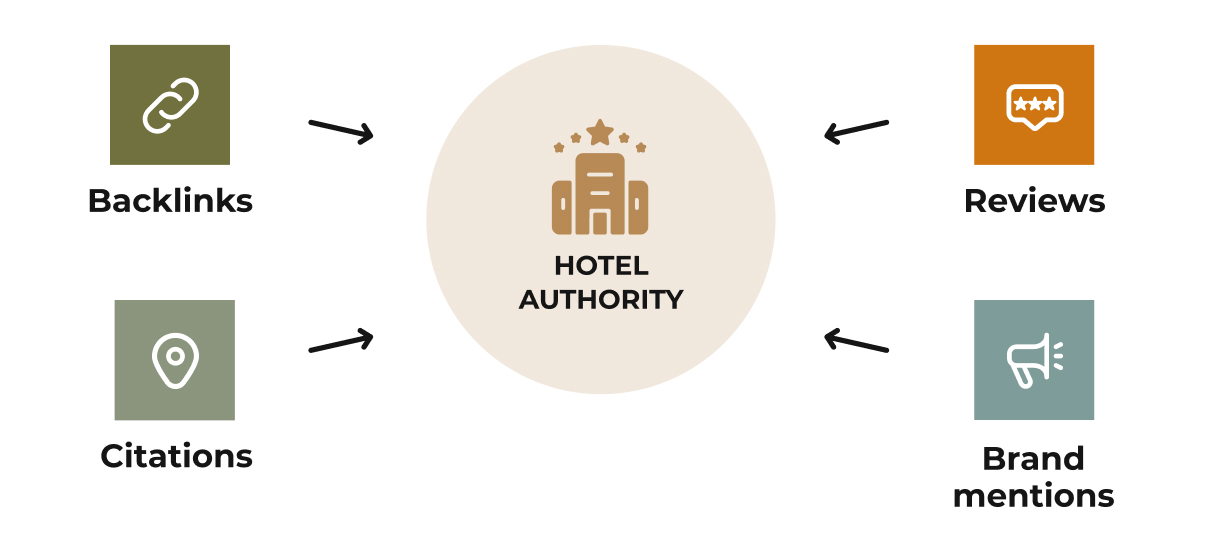
Together, these off-page signals help search engines evaluate whether your hotel deserves a prominent position in results. A strong off-page profile says: this property is real, trusted, and worth recommending. A weak one says: I’m not sure.
Why off-page SEO is critical for hotel marketing
Let’s be direct about what’s at stake here.
OTAs take between 15% and 25% commission on every booking they generate for you. That’s not a small number. On a $200 room, that’s up to $50 per booking going to a middleman. Across a season, it compounds quickly.
Direct bookings consistently outperform OTA bookings on revenue. The SiteMinder 2025 report found that hotel websites generated an average of $516 per booking, well above the $312 average from OTA channels. The difference is real, and it shows up directly in your margins.
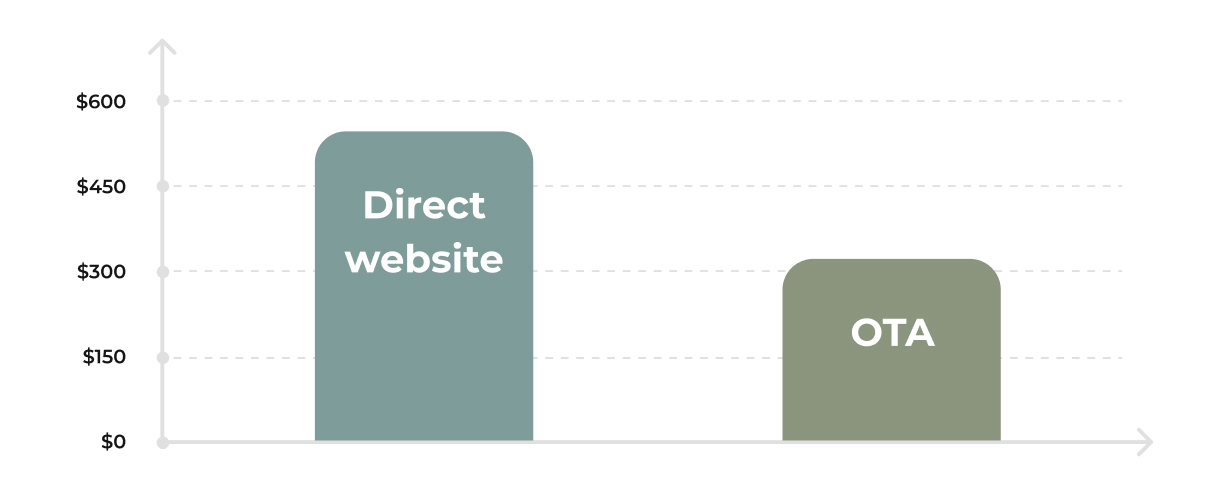
Off-page optimization is one of the primary drivers of that shift.
Why? Because travelers don’t book the first hotel they think of. They research. They search. They compare. Travelers consume an average of 303 minutes of travel content in the 45 days before booking a trip. Your property needs to show up favorably across those touchpoints, not just on your own website.
Strong off-page SEO improves your position in Google Maps, the local pack, and organic results. BrightLocal’s SEO research found that 42% of local searchers click on map pack results. Hotels not appearing there lose nearly half their potential local traffic to properties that do.
The math is pretty clear. Off-page SEO isn’t a nice extra. It’s part of the direct booking strategy.
Core off-page SEO strategies for hotels
This section is the practical part. Each strategy below is specific to hotels and built around the realities of how travelers search and how Google evaluates hospitality properties.
Link building for hotel websites
Backlinks are still one of the strongest signals in Google’s ranking algorithm. Backlinko’s analysis of 11.8 million Google search results found that pages ranking in position 1 have 3.8 times more backlinks than pages in positions 2 through 10.
That’s a significant gap, and it compounds the longer you ignore it.
But for hotels, volume is almost beside the point. What matters is relevance and authority.
A single link from a respected travel publication or regional tourism board carries more weight than dozens of links from generic directories.
A DR 70+ domain, for example, is a site that major publishers, established news organizations, and well-known industry leaders typically occupy. One link from a site in that tier delivers significantly more ranking power than a batch of links from low-authority sources. Focus on quality every time.
Here’s where to focus your link building efforts:
- Travel blogger outreach. Connect with bloggers and content creators who write about your destination. Offer a press stay in exchange for honest coverage. The resulting post and backlink reach an audience that’s already planning travel to your area.
- Local tourism partnerships. Your regional tourism board, convention and visitors bureau, and local event sites are natural partners. Getting listed or mentioned on their pages gives you a relevant, authoritative link and often drives direct referral traffic.
- PR and media mentions. A story about a unique guest experience, a property renovation, or a community initiative can earn coverage in travel publications, local news outlets, and hospitality trade media. Each mention is a potential backlink, and the brand visibility compounds.
- Guest posts on travel sites. Writing useful content for travel blogs or hospitality industry publications puts your name and link in front of audiences that trust those sources.
One tactic worth mentioning with caution: event sponsorship links. Sponsoring a local event in exchange for a website link can work. But Google has flagged this type of link as potentially manipulative if done purely for SEO benefit. Use it sparingly and only for events where the partnership is genuinely relevant to your brand.
Local SEO and citations for hotels
Local citations are mentions of your hotel’s name, address, and phone number (NAP) across the web. They might seem like a small detail, but these three pieces of data are what Google cross-references across the web to verify that your hotel is a real, legitimate business at a specific location.
As such, NAP consistency matters enormously here. Inconsistency weakens your local authority.
Your Google Business Profile is the most important citation you have. It’s what powers your appearance in Google Maps and the local pack. Fill it out completely: category, description, photos, amenities, check-in times, and your booking link. Keep it updated and active. According to Google, a complete and up-to-date business profile is an important factor for improving your local rankings.
Beyond Google, make sure your NAP is consistent and accurate across:
- TripAdvisor
- Booking.com and other OTA profiles
- Yelp
- Local chamber of commerce listings
- Regional tourism directories
- Bing Places
Run a citation audit every six months. Small discrepancies that build up over time can quietly drag your local rankings down without any obvious cause.
Local citation audit checklist
| Platform | Verified | NAP correct | Updated Photos |
|---|---|---|---|
| Google Business Profile |  |
|
|
| TripAdvisor | |
|
|
| Booking.com | |
|
|
| Yelp | |
|
|
| Bing Places | |
|
|
Online reviews and reputation management
This one deserves your full attention because reviews do two jobs at once. They influence whether a traveler books with you. And they directly affect where you rank.
MARA Solutions’ 2025 research found that 81% of travelers always read reviews before booking a hotel. A further 86% say they would pass on a good deal from a property with numerous unaddressed negative reviews. That’s your conversion rate at stake.
On the rankings side, according to Search Engine Land, star ratings, reviews count, and review velocity influence how you rank in the local pack. More reviews, more recent reviews, and higher average ratings all push you up in local results.
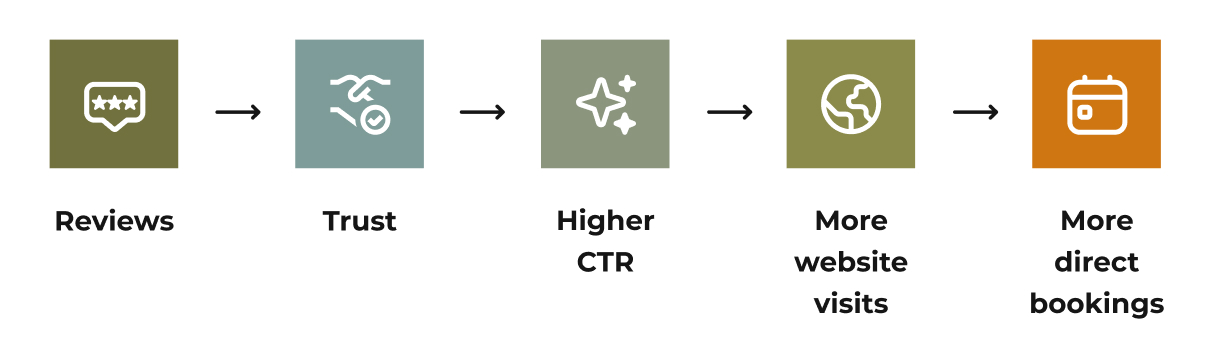
Here’s how to build a strong review profile:
Ask every happy guest. The best time to ask is right after checkout, when the experience is fresh. A simple message via email or SMS with a direct link to your Google or TripAdvisor review page removes all friction.
Respond to every review, positive and negative. A thoughtful response to a negative review often does more for your reputation than the review itself. It shows prospective guests that you listen.
GuestTouch, a hotel reputation management platform, reported that properties with strong recent scores typically see 15-20% higher booking conversion rates on the platform.
Best practices for review management:
- Respond within 24-48 hours of every new review.
- Thank guests by name where possible.
- Address specific complaints factually, without being defensive.
- Avoid offering compensation publicly in response to negative reviews.
- Flag reviews that violate platform guidelines.
Review volume and recency matter. A hotel with 50 detailed, recent reviews will frequently outrank one with 200 older reviews that stopped coming in a year ago.
Response templates
| Review type | Response goal |
|---|---|
| Positive Review | Reinforce loyalty |
| Neutral Review | Encourage return visit |
| Negative Review | Rebuild trust |
| Fake Review | Report and document |
Social media signals and brand mentions
Let’s address a common misconception first. Social media links generally don’t pass direct PageRank to your website. A link posted on Instagram or Facebook is treated as nofollow, meaning it doesn’t pass the same authority as a link from an editorial source.
But that doesn’t make social media irrelevant. Not even close.
Social platforms generate brand visibility that feeds your off-page SEO indirectly. When more people see your property, search for it by name, and talk about it online, those signals contribute to Google’s understanding of your brand’s authority and relevance.
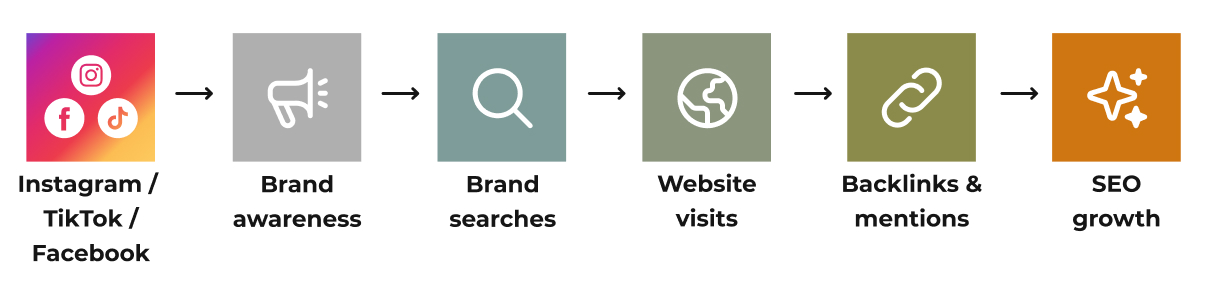
For hotels, Instagram is particularly powerful. Visual content showcasing rooms, experiences, and local surroundings reaches travelers in the research phase. A strong Instagram presence generates user-generated content when guests post photos and tag your property, which in turn creates brand mentions and potential linking opportunities.
Here’s where to put your energy:
- User-generated content (UGC). Encourage guests to share their stay with a branded hashtag. Repost their content (with permission). UGC builds authenticity that no amount of polished brand photography can replicate.
- Influencer collaborations. A well-chosen travel influencer visiting your property can reach tens of thousands of people in your target audience. Unlike a press stay with a journalist, an influencer’s post is often live within days and generates immediate engagement.
- Social engagement. Respond to comments, questions, and messages promptly. Social engagement signals activity and legitimacy to both platforms and search engines.
The indirect path from social media to SEO is real. It just works differently than a direct backlink.
Off-page SEO mistakes hotels should avoid
A few shortcuts and oversights can undo a lot of good work. Here are the most common ones:
- Buying spammy backlinks. Low-quality links from link farms and unrelated directories are worse than no links at all. Google’s spam filters are sophisticated, and a penalty is far harder to recover from than a slow start.
- Ignoring negative reviews. An unanswered bad review sends a message to every potential guest who reads it. Respond professionally. Every time.
- Inconsistent NAP. Small discrepancies across directories add up. So conduct a citation audit regularly.
- Relying entirely on OTAs for visibility. Your OTA profile helps guests find you, but it builds equity for Booking.com, not for you. Off-page SEO builds authority that your own website carries.
- Neglecting local partnerships. Tourism boards, local event organizers, and nearby businesses are your natural allies. Most hotels never reach out. That’s an opportunity sitting unused.
- Chasing volume over quality in link building. Ten relevant, authoritative backlinks outperform a hundred irrelevant ones. Focus where it counts.
Common off-page SEO mistakes
| Mistake | Consequence |
|---|---|
| Buying backlinks | Penalties |
| Ignoring reviews | Lower trust |
| NAP inconsistencies | Local ranking loss |
| OTA dependency | Reduced profitability |
| Weak local partnerships | Lost authority signals |
How to measure off-page SEO success for hotels
If you’re going to invest time in off-page optimization, you need to know whether it’s working. Here are the metrics worth tracking:
- Referring domains. The number of unique websites linking to you. Track this monthly in Ahrefs or Semrush. Growth in referring domains from relevant, authoritative sources is a strong positive signal.
- Local pack and map rankings. Are you appearing in the Google Map Pack for your key search terms? Track your position for searches like “hotel in [your city]” and variations. Tools like BrightLocal make this easy to monitor consistently.
- Google Business Profile insights. Google provides data on how many people viewed your listing, clicked through to your site, requested directions, and called you. These numbers tell you how your local visibility is performing in real terms.
- Review volume and average rating. Set a baseline and track it monthly across Google, TripAdvisor, and Booking.com. Are you gaining reviews consistently? Is your average rating stable or improving?
- Organic traffic. Overall visits from search engines, tracked in Google Analytics, reflect the cumulative effect of your SEO work. Look at the trend over three to six months, not week by week.
- Direct booking trend. This is the one that connects SEO to revenue. As your off-page authority grows, you should see a gradual shift in your booking channel mix toward direct. Track it in your property management system.
No single metric tells the full story. Watch all of them.
KPI dashboard
| KPI | Tool | Recommended frequency |
|---|---|---|
| Referring domains | Ahrefs | Monthly |
| Map pack rankings | BrightLocal | Weekly |
| Reviews | GBP, TripAdvisor | Weekly |
| Organic traffic | GA4 | Monthly |
| Direct bookings | PMS | Monthly |
| Citation accuracy | BrightLocal | Quarterly |
Conclusion
Off-page SEO for hotels isn’t about quick wins. It’s about building the kind of online authority that keeps working for you long after you’ve put in the initial effort.
Your rankings improve. Your reviews grow. Your name shows up in places travelers trust. And gradually, more of your bookings start coming through your own front door instead of through a platform that takes a cut of every one.
The hotels that commit to this consistently are the ones that will be hardest to compete with in two or three years. The ones that don’t will keep paying OTA commissions and wondering why their website traffic isn’t converting.
Start with what’s most actionable:
- Claim and fully complete your Google Business Profile.
- Audit your citations for NAP consistency.
- Put a system in place to collect guest reviews after every checkout.
These three steps alone will help you see significant results faster than most hotels expect.
Every strategy in this guide is something you can start on today. If you’d rather have a specialist team handle it, our hotel SEO services are built specifically for hospitality businesses that want more direct bookings and less OTA dependence.
The competition for direct bookings is getting more intense, not less. What off-page work is your hotel doing to stay visible?