

Andy Zenkevich is the Founder and CEO of Epiic, a hospitality marketing agency helping boutique hotels and experiential stays grow direct bookings through data-driven marketing, SEO, content, and operational strategy.
Picture a traveler on their phone, typing “best boutique hotel in Nashville for a couple” into ChatGPT instead of Google.
They get one clean answer. Three names, maybe. No scrolling, no 10 open tabs, no comparing five OTA listings side by side.
If your property isn’t one of those names, you just lost a guest who never even reached your website. And you probably didn’t notice it happened.
That’s the new reality of the hospitality industry AI search. Travelers are asking conversational questions to tools like ChatGPT, Perplexity, Google AI Overviews, Gemini, and Microsoft Copilot, and those tools are summarizing hotels instead of simply listing links to them.
Hotels now compete for citations and recommendations, not just rankings. A property can rank number one on Google and still be invisible in an AI answer.
That gap matters for direct bookings and for brand visibility, as fewer travelers ever reach a traditional results page to find you.
This isn’t a theory piece. It’s a practical roadmap for what to fix, in what order, and why each piece matters. Let’s get into it.
Key takeaways:
- AI search for hotels is growing fast: around 40% of US travelers used generative AI tools like ChatGPT extensively for trip planning in 2024.
- AI systems evaluate signals across your whole digital footprint, not just your homepage: structured data, reviews, brand mentions, and consistent facts everywhere your property is listed.
- Five out of six hotel properties are currently invisible in AI-generated travel answers, according to HotelWorld AI’s 2025 Index.
- Being recommended and capturing the booking are two separate problems. Many AI answers still route travelers to OTAs instead of hotel websites.
- Technical SEO (search engine optimization), structured data, and strong content still form the foundation. AI search builds on top of that; it doesn’t replace it.
How AI search is changing the hospitality industry
Not long ago, a traveler planning a trip searched Google, opened five tabs, and compared prices across two or three OTAs before landing on a hotel website, if they got there at all.
That process is shifting. Potential guests now type full sentences into AI platforms instead of short keyword strings.
Instead of “hotel Nashville,” someone types “best boutique hotels in Nashville for couples.” Instead of “hotel Denver pool,” it’s “family hotels in Denver with a rooftop pool.”
Other real examples look like “pet-friendly hotels near Central Park in New York,” “quiet business hotels near downtown Austin,” or “affordable beachfront hotels in San Diego for a long weekend.” These are full questions, asked the way you’d ask a friend for a recommendation, from travelers headed to cities all over the country instead of just one region.
Here’s the part that changes everything for hoteliers and hotel marketing as a whole: AI-powered search engines don’t rank 10 blue links and let the traveler choose. They generate one answer by pulling from multiple trusted sources at once, then present it as a finished recommendation.
That’s a fundamentally different kind of search. Google’s own AI Overviews now appear on more than 20% of all searches, and that share keeps climbing, according to Similarweb’s 2026 zero-click research.
The traffic pattern behind this is stark. Pew Research Center found that people click through on just 8% of searches when an AI Overview shows up, compared with 15% when it doesn’t, based on the browsing activity of 900 US adults tracked in March 2025.
Fewer clicks means fewer chances for your hotel to be discovered the old-fashioned way. AI-based recommendations, zero-click answers, and multi-source summaries are becoming the default experience, not the exception.
So what changes for you? Your job is no longer just to rank a webpage. It’s to become a source AI systems trust enough to cite by name.
That’s a bigger shift than it sounds, and it’s why the rest of this guide focuses on becoming that kind of trusted source.
Why AI search matters for hotels and hospitality businesses
Set the technology aside for a second and focus on outcomes. Why does any of this matter to your bottom line?
Visibility in AI touches nearly every part of how a guest chooses your property. Brand awareness, trust, and consideration during trip planning all happen before a traveler ever opens your booking page.
The modern guest journey now looks something like this: awareness, research, AI recommendation, website visit, then booking. Miss that middle step and the rest of the journey often doesn’t happen for you.

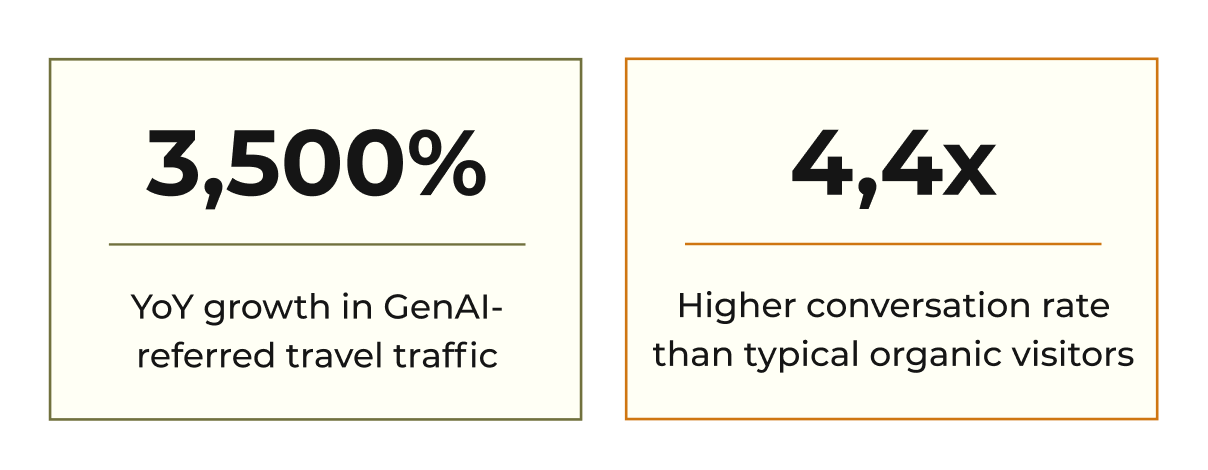
Adobe Analytics tracked GenAI-referred traffic to travel sites growing 3,500% year over year in July 2025. That’s from a small base, but the direction is unmistakable.
Visitors who do arrive from AI platforms tend to convert at 4.4 times the rate of typical organic visitors. These are travelers who already got a recommendation and just need to confirm the details.
Here’s the uncomfortable part. If your hotel is absent from AI answers, you may be removed from consideration before the traveler even opens Google.
The traveler never sees a missing option. They just see the three hotels the AI did mention, and they book one of those.
That’s not a ranking problem anymore. It’s a visibility problem that happens one step earlier in the funnel, which is exactly why AI-driven search deserves its own strategy instead of being treated as a side effect of traditional SEO.
Reduced OTA dependence is the other piece of this. Being cited directly, with a link to your own site, keeps more of the booking value in your hands instead of an intermediary’s.
How AI systems choose which hotels to recommend
This is the section worth reading twice. AI models don’t rank pages the way Google’s classic algorithm does. They evaluate a set of signals and decide which properties are trustworthy enough to name.
| Signal | What AI evaluates |
|---|---|
| Website quality | Accuracy, specificity, freshness, and usefulness |
| Structured data | Hotel details expressed in machine-readable form |
| Brand authority | Independent mentions and trusted publications |
| Reputation | Recent reviews, ratings, and guest feedback |
| Entity understanding | Consistent name, location, amenities, and property type |
| Technical accessibility | Whether pages can be crawled, indexed, and interpreted |
Website quality
Helpful, specific content still forms the base layer. Clear information architecture, accurate hotel details, and content that’s kept fresh all give AI something concrete to work with.
Vague copy like “centrally located with excellent amenities” gives AI nothing to cite. Specific copy like “two blocks from Music City Center, with a rooftop pool open until 10pm” gives it exactly what it needs.
Structured data
Schema markup like Hotel Schema, Organization Schema, FAQ Schema, Review Schema, LocalBusiness Schema, Breadcrumb Schema, and Image Schema help AI systems and search engines read your page accurately.
Yes, I know that sounds too techie. In simple words, it’s just code added behind your website that labels things for machines the way a name tag labels things for people. That way, a computer doesn’t have to guess what’s a price, what’s a room type, and what’s an address.
Think of structured or schema-based data as a translation layer. It tells AI systems what your page contains in a format machines process instantly, rather than making them guess from paragraphs of prose.
| Schema type | What it clarifies | Recommended priority |
|---|---|---|
| Hotel | Property name, location, amenities, and rating | Essential |
| Organization | Brand and company information | Essential |
| LocalBusiness | Address, phone number, and local business details | Essential |
| Breadcrumb | Site hierarchy and page relationships | High |
| ImageObject | Image ownership and context | Medium |
| FAQPage | Question-and-answer content | Use selectively |
| Review / AggregateRating | Ratings and review data | Only when eligible |
Brand authority
Mentions across trusted sites carry real weight. News articles, travel publications, local tourism websites, and industry partnerships all signal that your property is recognized beyond your own marketing.
A single glowing paragraph on your homepage doesn’t do this. A feature in a regional travel publication does.
Anyone can write flattering copy about their own hotel, so your own website is the least convincing witness for your property’s credibility. A journalist covering weekend trips, a tourism board listing you as a recommended stay, or a local blogger writing about the neighborhood are all independent voices vouching for you. And that’s exactly the kind of validation AI systems weigh heavily.
Brand authority compounds slowly, one guest post or trade mention at a time. That’s also why it’s hard for a new competitor to copy quickly.
Reputation signals
AI often draws on reviews, ratings, guest experiences, and third-party trust signals to decide who deserves a recommendation. Consistent, recent, positive feedback strengthens that picture.
Why does this carry so much weight? Because reviews are one of the few data points AI can treat as independent verification as opposed to being something your own marketing team wrote.
Recency also matters more than most hoteliers expect. A property with hundreds of reviews from three years ago and nothing since can look less trustworthy than a newer hotel getting fresh feedback every week.
Spread this across platforms rather than concentrating it on one. Google, Tripadvisor, Booking.com, and Expedia all feed different AI tools, so a strong profile on only one of them leaves gaps everywhere else.
Entity understanding
AI needs confidence about who and what your hotel actually is. That includes your hotel name, location, amenities, brand, property type, and nearby attractions.
Inconsistent or incomplete information anywhere in that picture makes AI systems less confident, and less confident systems recommend something else. Your own on-page SEO work plays a direct role here, since clean headings, accurate metadata, and clear content all reinforce entity understanding.
This is where entity SEO comes in. Google’s Knowledge Graph already connects your hotel name to a specific place, a set of attributes, and a location on the map, and AI tools lean on that same kind of connected data.
Give every platform the exact same facts about your property: a complete Google Business Profile, a consistent listing on data aggregators, and matching details on every OTA page that mentions you. Fewer inconsistencies mean fewer reasons for AI to guess.
Content that performs well in AI search for hospitality
Generic destination content is losing ground fast. A vague “top 10 things to do” article that reads like 50 others won’t earn a citation.
What works instead is content built around real traveler questions, written to answer them directly and completely.
Hotel guides
Cover the best time to visit, neighborhood guides, transportation options, local attractions, and event guides tied to your destination. These answer the exact questions a traveler types into an AI assistant before they even search for a hotel by name.
Planning content
Weekend itineraries, family travel guides, business travel tips, honeymoon planning content, and seasonal travel advice all give AI concrete, citable material.
Decision-making content
Hotel comparisons, room type breakdowns, amenities explained in detail, parking information, pet policies, resort fee transparency, and a clear check-in process description all remove friction at the exact moment a traveler is deciding.
FAQ content
Recommend short, direct answers placed near the top of the page. AI tools consistently prefer short answers, lists, tables, bullet points, clear definitions, and clean headings over dense paragraphs.
Write for two readers at once here: the human scanning your page on their phone and the AI system trying to extract a quotable answer from it. The two goals overlap more than most hoteliers expect.
Building trust signals beyond your website
AI doesn’t just read your website. It reads your entire digital footprint and cross-references what it finds.
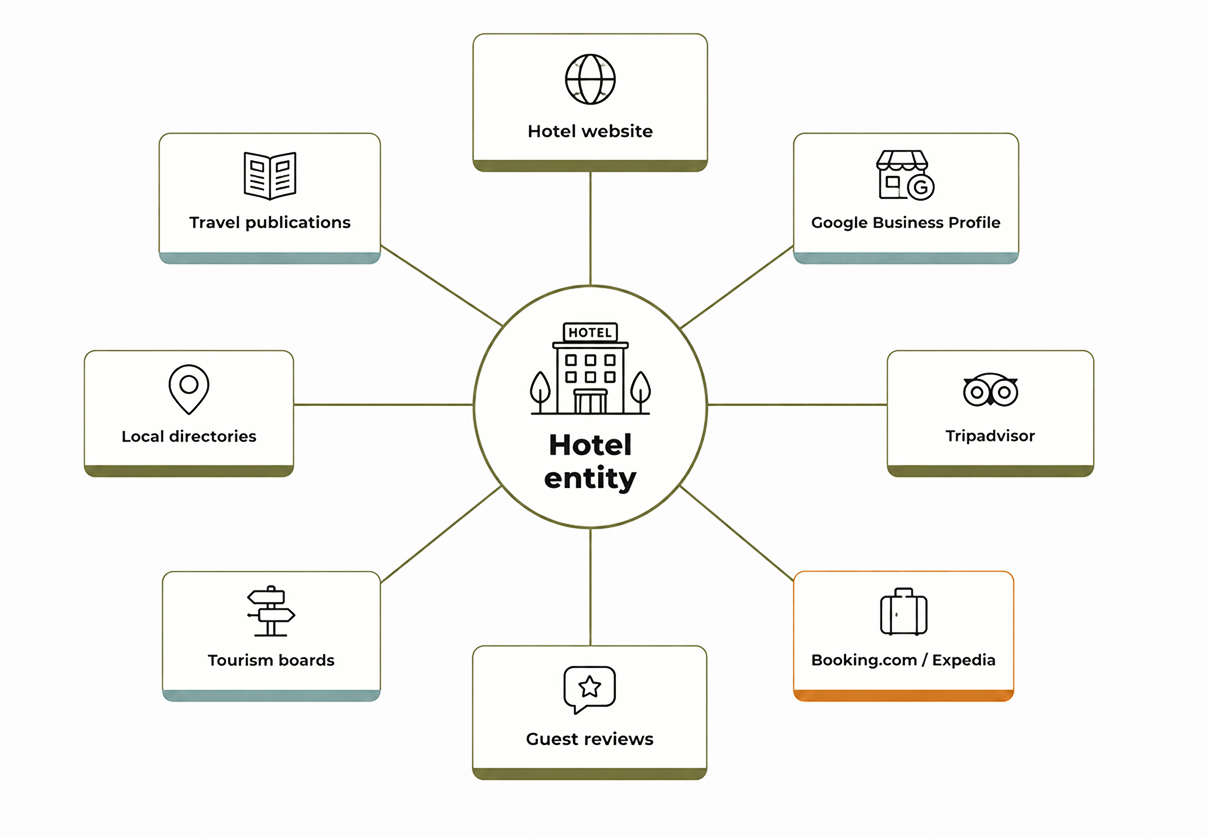
That footprint includes your Google Business Profile, Tripadvisor, Booking.com, Expedia, tourism boards, destination marketing organizations, local directories, review platforms, news mentions, travel blogs, and social proof.
Perplexity, for example, launched a partnership with Tripadvisor in January 2025 specifically to enrich its hotel answers with reviews, ratings, and property details. That single integration makes your Tripadvisor profile worth a serious audit.
Consistency across every one of these platforms matters more than most operators assume. Your hotel name, address, phone number, website, amenities, categories, and images all need to match exactly, everywhere.
Why? Because inconsistencies read as a red flag to AI search engines the same way they confuse human readers trying to verify a business is legitimate.
A slightly different phone number on one directory or an outdated amenity list on another chips away at the confidence AI needs to recommend you. Small gaps compound quietly over time.
Building genuine off-page SEO signals, earned mentions, consistent listings, and steady review growth does double duty here. It helps traditional rankings and AI visibility at the same time.
Technical SEO still matters in the AI era
Some hoteliers assume AI search makes technical SEO optional. That’s backward.
AI cannot recommend a page it cannot properly crawl, index, or understand. The technical foundation matters more, not less, in this new environment.
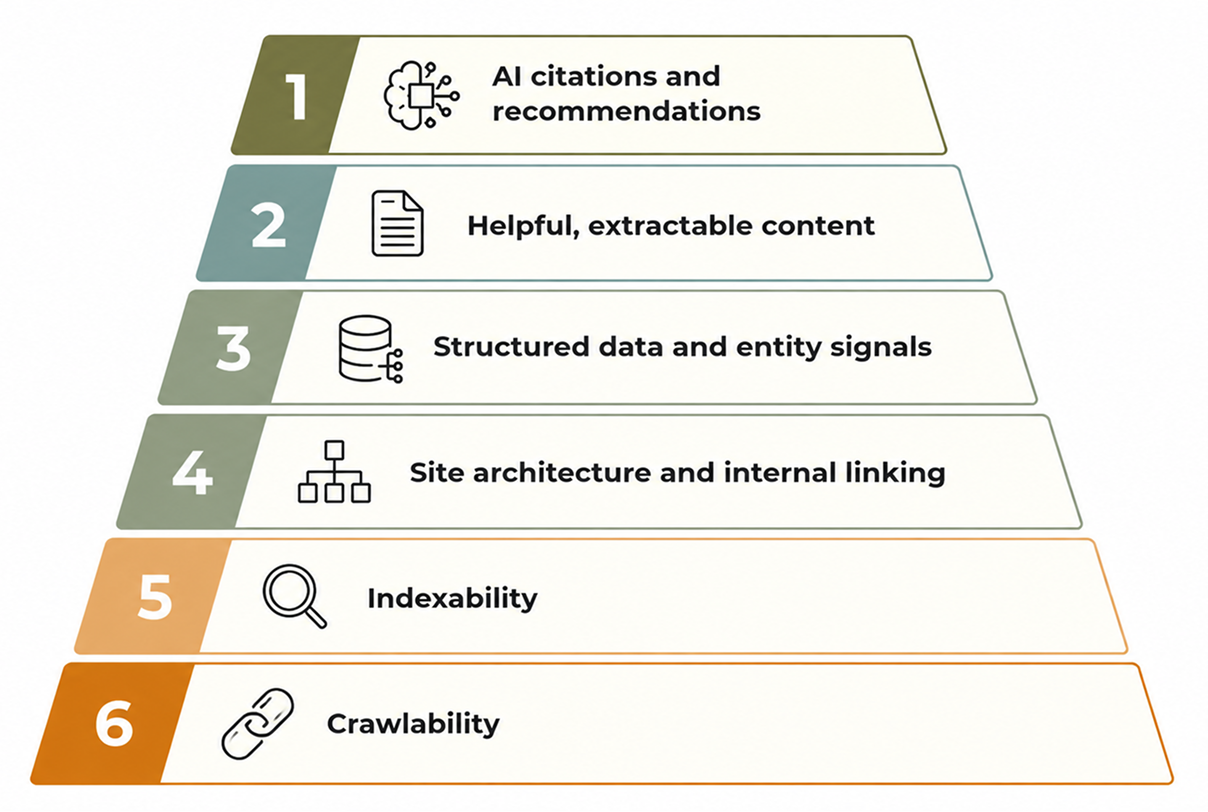
Crawlability and indexability come first. If AI crawlers can’t access your pages, none of your content strategy matters.
Internal linking, XML sitemaps, and canonical tags help both traditional search engines and AI systems map your site correctly. Fast-loading pages, mobile usability, strong Core Web Vitals, HTTPS, and clean URL structure round out the list.
Structured data deserves another mention here, as it sits at the intersection of technical SEO and AI readability. Getting the technical basics right, the kind covered in our hotel SEO guide, is still the floor everything else stands on.
None of this is glamorous. It’s the quiet infrastructure that decides whether AI can even see you in the first place.
Practical AI search optimization checklist for hotels
Save this list. Work through it one item at a time rather than trying to fix everything in a single afternoon.
- Build complete Hotel Schema. It gives AI a structured, machine-readable summary of your property.
- Create location pages. These target the specific neighborhood and area questions travelers ask AI tools.
- Publish local travel guides. Detailed, destination-specific content gives AI something concrete to cite.
- Answer traveler FAQs directly. Short, clear answers get extracted far more often than long paragraphs.
- Strengthen author pages. Named, credentialed authors support E-E-A-T and signal real expertise behind the content.
- Maintain your Google Business Profile. It feeds directly into AI Overviews and many Google AI Mode answers.
- Encourage authentic guest reviews. Fresh, detailed reviews are a trust signal AI systems weigh heavily.
- Improve internal linking. It helps AI understand how your pages relate to each other.
- Keep amenities updated everywhere. Outdated details anywhere in your footprint reduce AI confidence.
- Add comparison content. Room type and rate comparisons match how travelers phrase AI queries.
- Publish seasonal travel content. It captures time-sensitive questions AI tools answer year-round.
- Monitor AI-generated answers about your property. You can’t fix what you haven’t checked.
- Improve brand mentions. Coverage in travel publications builds the authority AI platforms look for.
- Build high-quality backlinks. Authority still transfers, whether the destination is a search result or an AI answer.
- Track AI citations over time. This is the new visibility metric worth watching closely.
How to measure success in AI search
Traditional rankings alone no longer tell the full story of your visibility.
New KPIs worth tracking include AI citations, brand mentions inside AI answers, referral traffic from AI platforms, organic visibility, direct traffic, branded search volume, booking conversions, review growth, and share of voice against competitors.
Bing Webmaster Tools now includes an AI Performance dashboard covering citations and page-level activity across Microsoft Copilot and Bing AI summaries, which is worth checking since ChatGPT relies on Bing as a search partner behind the scenes.
Track these metrics alongside your existing SEO reports rather than replacing one with the other. Rankings still matter. They’re just no longer the whole picture.
Conclusion
AI search is changing how travelers discover hotels. It isn’t replacing SEO.
The hospitality brands winning right now are combining strong technical SEO, genuinely helpful content, a solid reputation, consistent brand signals, structured data, and guest experiences good enough to earn real reviews.
The properties most likely to show up in AI-generated recommendations are simply the ones that are easiest for people and AI systems alike to understand and trust.
Every tactic in this guide is something you can start on today. If you’d rather have a specialist team handle it, our hotel SEO services are built specifically for hospitality businesses that want more direct bookings and less OTA dependence.
So, where does your property stand in an AI answer right now? Go ask ChatGPT or Gemini for a recommendation in your own city and see if your name comes up.