

Andy Zenkevich is the Founder and CEO of Epiic, a hospitality marketing agency helping boutique hotels and experiential stays grow direct bookings through data-driven marketing, SEO, content, and operational strategy.
You’re paying 15 to 25% commission on every booking that comes through an OTA. And that number is climbing.
If that stings, you’re not alone. Cloudbeds’ 2026 State of Independent Hotels Report found that OTAs captured 63.4% of all bookings for independent properties last year. That’s more than half of your rooms going through a middleman who takes a cut of every single one.
The guests were ready to book. They just didn’t end up booking with you directly.
Hotel PPC advertising changes that. It puts your property at the top of search results right when travelers are actively looking for a place to stay.
This guide covers how hotel PPC works, what a strong hotel PPC strategy looks like, and what mistakes to avoid when running your campaigns. Let’s walk through it.
Key takeaways:
- Hotel PPC places your property in front of travelers who are actively searching and ready to book.
- PPC for hotels works across Google Ads, Google Hotel Ads, Meta Ads, and travel metasearch platforms.
- A well-planned hotel PPC campaign drives direct bookings and cuts your dependence on high-commission OTAs.
- Targeted bidding, compelling ad copy, and optimized landing pages are what separate profitable campaigns from wasted spend.
- Tracking conversions and refining your hotel PPC strategy regularly is what keeps campaigns performing.
What is hotel PPC?
Hotel PPC (pay-per-click) is a digital advertising model where hotels pay a fee only when a user clicks their online ad.
For hotels, that means your property can appear at the very top of search results when a traveler types in something like “boutique hotel in Austin” or “family resort near Orlando.” You bid on those keywords, your ad runs, and you only pay when someone actually clicks through to your site.
Hotel PPC campaigns run across several platforms:
- Google Ads
Text-based search ads that appear above organic results when travelers search for accommodation. - Google Hotel Ads
A metasearch product that displays your live rates and availability directly in Google Search and Google Maps, side by side with OTA listings. This gives travelers a one-click path to your direct booking engine. - Meta Ads (Facebook and Instagram)
Image and video ads that target travelers based on interests, behaviors, and past interactions with your property. - Travel metasearch platform
Tripadvisor, Trivago, and Kayak, which aggregate rates from multiple sources and let hotels display their direct rate alongside OTA options.
Hotel PPC platforms comparison
| Platform | Best for | Ad format | Booking intent |
|---|---|---|---|
| Google Ads | Demand capture | Search ads | Very high |
| Google Hotel Ads | Direct bookings | Rate listings | Extremely high |
| Meta Ads | Awareness & remarketing | Image & video | Medium |
| Tripadvisor | Comparison shoppers | Metasearch | High |
| Trivago | Rate comparison | Metasearch | High |
| Kayak | Travel planning | Metasearch | High |
Each platform works a bit differently, but the principle is the same. You pay for clicks from travelers who are already in the mindset of finding a place to stay.
Targeting is what makes hotel PPC genuinely powerful. You can narrow your audience by destination search, travel dates, location, device type, and even past website visitors. That kind of precision is something a brochure or a billboard will never give you.
Why PPC is important for hotels
Pay-per-click (PPC) advertising is essential for hotels because it guarantees top visibility on search engines exactly when travelers are ready to book.
OTA commissions eat into your margins every single booking. According to PhocusWire, the standard rate sits at 15 to 25% per reservation, and the burden has only gone upward in recent years. A direct booking at the same room rate keeps that money in your pocket.
Hotel PPC gives you four things that are genuinely hard to get anywhere else.
1. Immediate visibility in search results
SEO is a long game. It takes months of consistent work before you start seeing results. PPC for hotels is the opposite. Launch a campaign today and your property can appear at the top of search results this afternoon.
That matters especially during peak booking windows, event weekends, and last-minute travel surges when you need visibility right now.
2. Increased direct bookings
The goal of hotel PPC is straightforward: get travelers from a search engine to your booking engine, without an OTA in the middle.
Google Hotel Ads, for example, accounts for 65% of all metasearch-driven bookings, according to data from Roiback. When your direct rate appears next to OTA listings in that format, you’re giving travelers a clear path to book with you directly. Fewer commissions. Better margins. More control over the guest relationship.
3. Highly targeted advertising
With hotel PPC, you’re not broadcasting to everyone. You’re putting your ads in front of travelers who are searching for exactly what you offer.
You can target by destination keyword (“beachfront hotel in Miami”), travel dates, geographic location of the searcher, device type, and remarketing audiences (people who have already visited your website). That’s a level of precision that makes every dollar of your budget work harder.
4. Measurable results
This is one of the biggest advantages PPC for hotels has over traditional advertising. Every click, every conversion, every booking gets tracked.
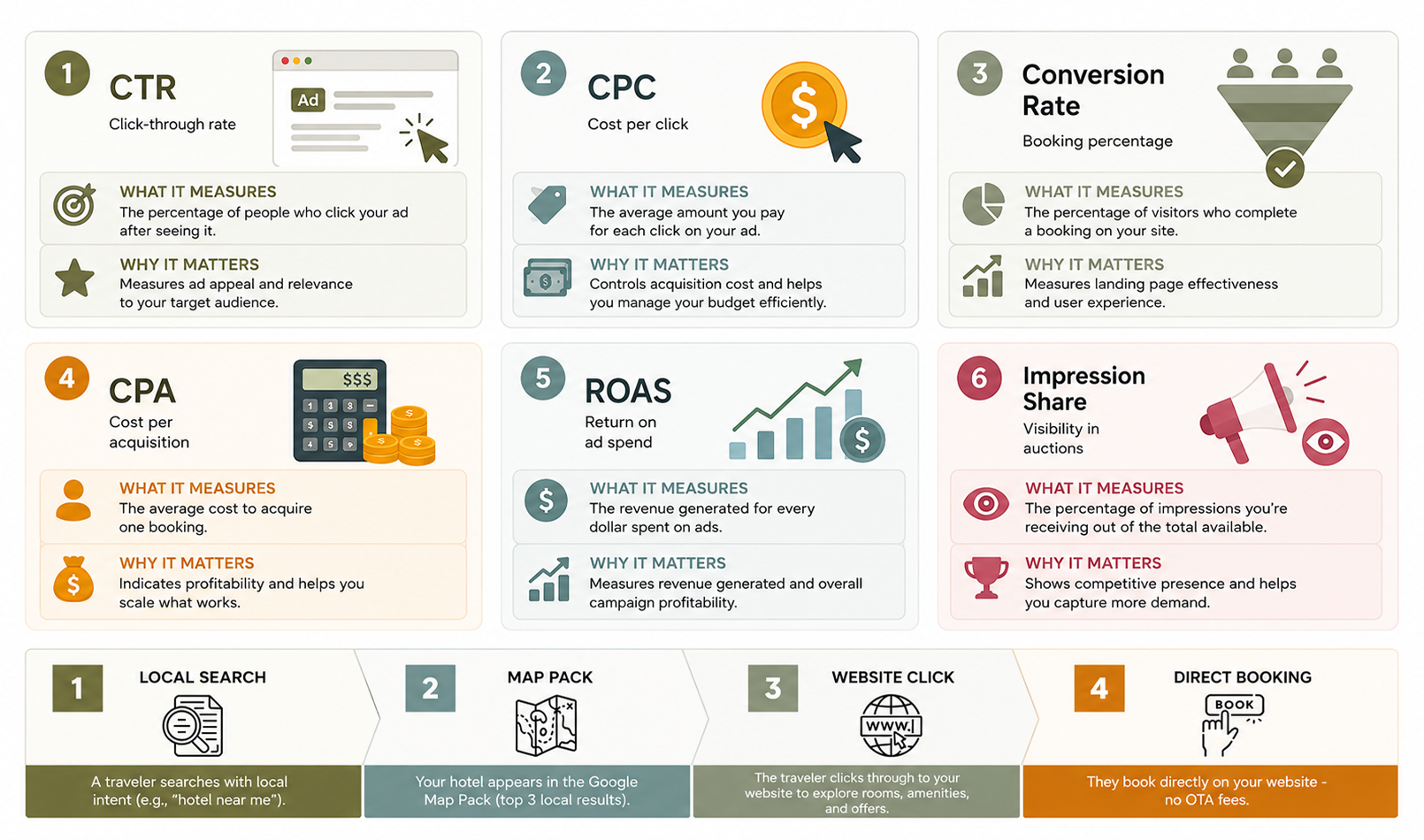
You know your cost per click. You know your conversion rate. You know your return on ad spend. The travel and hospitality industry averages a click-through rate of 8.24% on Google Ads, which is the highest across all sectors.That’s an audience that clicks. The question is whether they’re clicking to your site or to an OTA.
Hotel PPC vs other hotel marketing channels
| Channel | Speed of results | Direct bookings | Cost control | Scalability |
|---|---|---|---|---|
| Hotel PPC | Immediate | High | High | High |
| SEO | Long-term | High | Medium | High |
| OTAs | Immediate | Low | Low | Medium |
| Social Media Organic | Slow | Medium | High | Medium |
| Email Marketing | Fast | High | High | Medium |
How hotel PPC campaigns work
A hotel PPC campaign has a straightforward flow, but getting it right takes care at every step.
- Keyword research.
Everything starts with the searches your potential guests are actually running. “Hotel in New York City” is too broad and too expensive. “Boutique hotel near Times Square with breakfast” is the kind of specific, high-intent phrase that tells you exactly who’s searching and how close they are to booking. - Ad creation.
Your ad needs to earn the click. That means leading with what makes your property worth choosing: your location, a current promotion, a standout amenity, or a price advantage over what the OTAs are showing. - Target audience.
Your visuals and messaging need to match the guests you actually want. A 55+ resort running a photo of a young family on a waterslide draws the wrong clicks. Get this right before anything else. - Bidding.
You set a maximum bid for each keyword. Google’s auction system then determines your ad placement based on your bid, your ad quality score, and the relevance of your landing page. Higher-quality ads pay less for the same placement. - Landing page.
This is where most hotels lose the booking. Your ad promises something specific. The page the traveler lands on needs to deliver that same message immediately, load fast, and make the path to booking completely obvious. - Conversion tracking.
Without tracking, you’re guessing. Set up conversion tracking so you know which keywords, ads, and audiences are actually generating bookings, not just clicks.
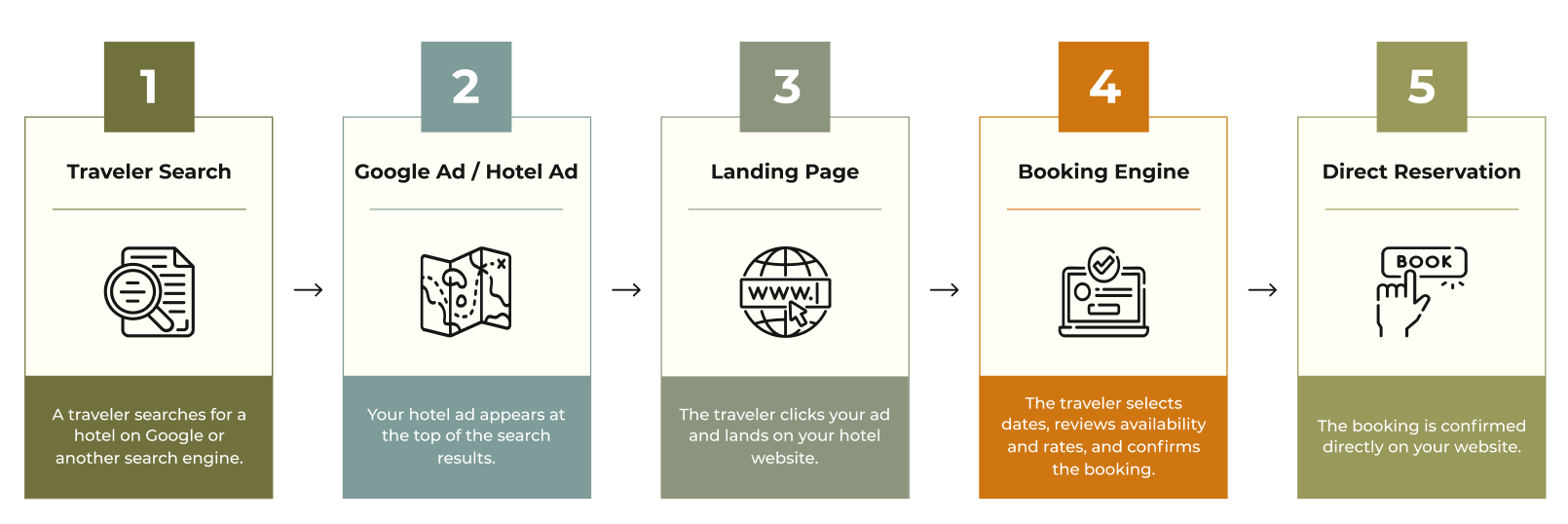
The customer journey looks like this: traveler searches, sees your ad, clicks through, lands on your property page, and books directly. That’s the chain you’re building. Break it at any link and you lose the booking.
Key components of a successful hotel PPC strategy
Running hotel PPC ads is not the same as running a hotel PPC strategy. The difference is in how you approach each element below.
Keyword targeting that matches how travelers actually search
You need two types of keywords working together.
Branded keywords are searches for your property by name.
These protect you from competitors bidding on your brand and capture travelers who already know who you are. Non-branded destination keywords are how new guests find you: “luxury hotel in Santa Monica Beach” or “family resort near Portland.”
Go specific. Long-tail keywords like “pet-friendly hotel near Central Park” cost less per click and come from travelers who know exactly what they want.
Ad copy that makes travelers stop scrolling
Your ad has a fraction of a second to compete with OTAs that spend billions on advertising. Expedia spent $1.65 billion in a single quarter on ads in 2024.
Your copy needs to highlight what they can’t offer: a direct rate advantage, a flexible cancellation policy, a complimentary breakfast, or a room upgrade for direct bookers. Make the benefit clear. Make the call to action obvious. “Book direct and save 10%” beats “Visit our website” every time.
Optimized landing pages that convert
Sending paid traffic to your homepage is one of the most common and most costly mistakes in hotel PPC management. The page a traveler lands on should match the ad they clicked.
If your ad is about your rooftop suite package, the landing page should show the rooftop suite package. Fast loading, with clear photos and with a booking form that doesn’t ask for unnecessary information. One job: get the booking.
Budget and bid management that adapts to demand
Your hotel PPC budget should not be static. High season, major local events, and competitor promotions all change what it costs to appear at the top of results.
Raise bids during your peak booking windows. Pull back during periods where occupancy fills itself. Use dayparting to focus spend on the hours when travelers are most likely to book. A fixed budget with no adjustments is money left on the table.
Common mistakes in hotel PPC campaigns
Most hotels that try hotel paid search and walk away disappointed made at least one of these mistakes:
- Targeting keywords that are too broad. Bidding on “hotel” or “accommodation” means you’re competing against every property in the world for a traveler who hasn’t decided anything yet. Broad match burns budget fast and delivers poor returns.
- Sending traffic to the homepage. A traveler who clicked an ad for your spa weekend deal does not want to arrive at your homepage and start searching. They want the deal. Send them there.
- Not tracking conversions. If you can’t see which clicks are turning into bookings, you can’t optimize. This is the single most important technical setup for any hotel PPC campaign.
- Ignoring mobile users. Most travelers search and research on their phones. If your landing page loads slowly or the booking form is hard to use on a small screen, you’re losing bookings. Mobile performance is not optional.
- Setting it and forgetting it. Hotel PPC campaigns need regular attention. Keyword performance shifts. Competitor bids change. Seasons turn. A campaign that was profitable in March can be wasteful by June without adjustments.
Why do these matter so much?
Each one compounds the problem. Broad keywords bring in unqualified clicks. Those clicks land on a generic page. No conversion tracking means you never see it happening. Meanwhile, mobile users bounce. And with no one optimizing the campaign, it keeps repeating. That’s not a hotel PPC strategy. That’s a slow budget drain.
Final thoughts on PPC for hotel marketing
Hotel PPC is one of the most direct paths between a guest’s search and your booking page.
It gives you visibility on day one. It puts your direct rate in front of people who are ready to book. And it gives you data that tells you exactly what’s working and what isn’t.
A well-built hotel PPC strategy is not just about spending money on ads. It’s about owning the moment when a traveler is most likely to choose you. Every direct booking you capture through paid search is one less commission paid to an OTA. Across a full year, that gap in cost becomes a real advantage.
Test your campaigns. Refine your keywords. Fix your landing pages. Keep tracking.
The hotels that treat hotel PPC as an ongoing discipline, not a one-time experiment, are the ones that consistently pull bookings away from the OTAs.
Every tactic in this guide is something you can start on today. If you’d rather have a specialist team handle it, our hotel ppc services are built specifically for hospitality businesses that want more direct bookings and less OTA dependence.
Are you currently running hotel PPC campaigns? What’s been the biggest challenge getting them to perform?