
Andy Zenkevich is the Founder and CEO of Epiic, a hospitality marketing agency helping boutique hotels and experiential stays grow direct bookings through data-driven marketing, SEO, content, and operational strategy.
Every time a guest books your room through Booking.com or Expedia, a slice of your revenue walks out the door.
Not a small slice, either. OTA commission fees typically run 15 to 30% per reservation, and they haven’t been trending down. If you’ve ever done the math on a busy month and felt the sting, you’re in good company.
OTAs captured 63% of bookings for independent properties in 2025, according to Cloudbeds. That’s more than half your rooms going through a middleman who keeps a cut and holds onto the guest data.
Direct bookings change that math completely. They put money back in your pocket, guest relationships in your hands, and data back where it belongs: with you.
This guide covers what hotel direct bookings are, why they matter, what’s getting in your way, 12 strategies that move the needle, how to measure success, and where the industry is heading next. Let’s dig in.
Key takeaways:
- Direct bookings eliminate OTA commissions of 15 to 30% and give hotels full control over guest relationships and data.
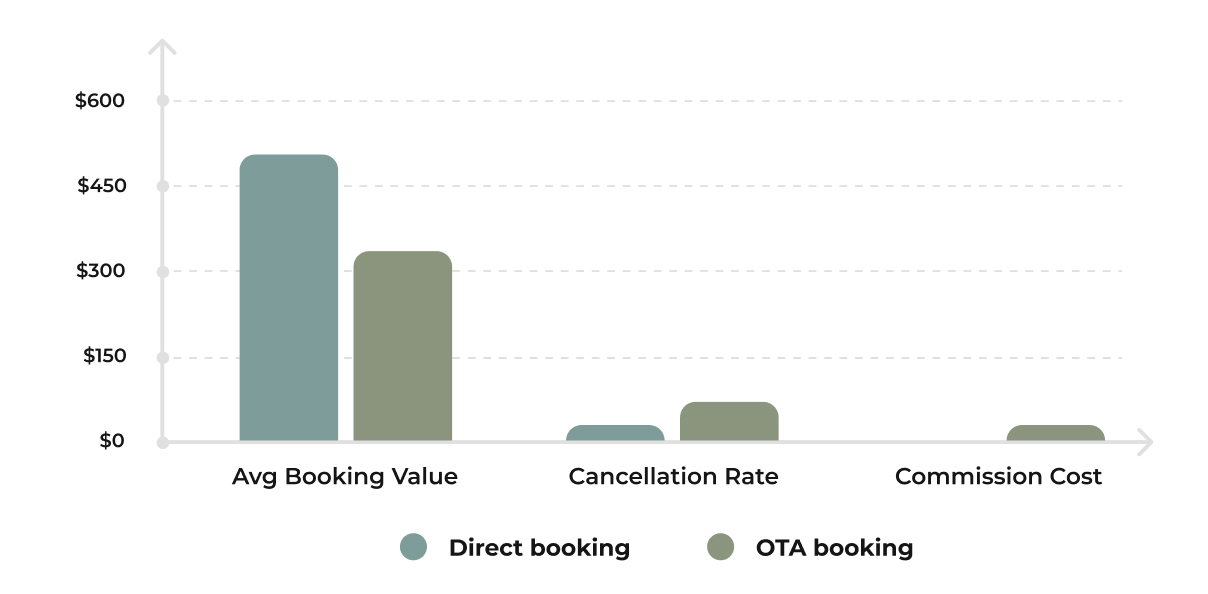
- The average direct booking value is at $519 versus $320 for OTAs, a 62% premium, according to a SiteMinder report.
- Loyalty programs, SEO, email marketing, and a strong booking engine are the core channels driving direct revenue for hotels that do this well.
- Mobile bookings made up 60% of all hotel reservations in 2024, making mobile optimization non-negotiable.
- A direct booking strategy is not a one-time project. It’s an ongoing discipline that compounds over time.
What are hotel direct bookings?
A hotel direct booking is any reservation made directly with the property, with no third-party platform in the middle.
The channels that count as direct include:
- Your hotel website (the most important one)
- Phone reservations
- Email inquiries
- A hotel mobile app
- Walk-in bookings
Contrast that with an OTA booking, where Booking.com, Expedia, Agoda, or Hotels.com acts as the go-between. The OTA handles the transaction, collects the commission, and, in most cases, keeps the guest’s contact details locked inside their platform.
| Direct booking channels | OTA booking channels |
|---|---|
| Hotel website | Booking.com |
| Phone | Expediam |
| Agoda | |
| Mobile app | Hotels.com |
| Walk-ins | Travelocity |
| Loyalty program | Other OTAs |
That’s not a minor inconvenience. It’s a structural problem.
With direct bookings, your property keeps the revenue, owns the relationship, and gets the data needed to market to that guest again.
Your booking engine, the reservation system embedded in your website, is the operational heart of this. It shows live availability, handles payments securely, and feeds bookings directly into your system without a middleman skimming a percentage on the way through.
Direct guests also tend to share more about themselves during the booking process: preferences, special requests, travel context. That information helps you personalize the stay, which increases satisfaction and the likelihood they will come back.
Why direct bookings matter in the hotel industry
Direct bookings matter in the hotel industry because they bring in higher profit margins, ownership of guest data, stronger customer relationships, and better brand loyalty. And all of these translate to revenue growth.
Let’s look at them in detail:
Higher profit margins
The commission math is straightforward. At a 20% OTA rate, a $200 room night costs you $40 just to the platform. OTAs also see cancellation rates near 50%, compared to around 18% for direct bookings.
That’s a double hit: you pay to get the booking, and then it walks away at a higher rate.
And the revenue per booking is genuinely different. SiteMinder’s analysis of 125 million reservations across 44,500 hotels found that direct website bookings averaged $519 versus $320 for OTAs, a 62% premium. Direct guests book higher-value rooms, stay longer, and add more extras.
Ownership of guest data
OTAs control the guest relationship, including the email address, booking history, and preferences. When someone books through Booking.com, you get an assignment, not a relationship.
Direct bookings flip that completely. You collect the contact details, travel preferences, and behavioral data that power smarter marketing campaigns and better stays.
That data is the raw material for everything from personalized pre-arrival emails to loyalty programs to post-stay follow-ups.
Stronger customer relationships
Direct guests are yours to communicate with. Before they arrive, you can send a welcome message, offer an upgrade, or suggest an add-on. During the stay, you can check in with a personal touch. After checkout, you can ask for a review and invite them back.
None of that is possible when a guest books through an OTA and their contact details sit behind someone else’s platform wall.
Better brand loyalty
Guests who book direct are already a step closer to becoming loyal guests. According to CBRE, hotel loyalty program membership surged 14.5 percent in 2024, reaching 675 million members and outpacing room supply growth of 6.7%. Loyalty members accounted for 52.8% of occupied rooms that year.
The connection between direct bookings and loyalty is a reinforcing loop. Book direct, join the program, earn points, book direct again. OTAs break that loop at the start.
Business impact of direct bookings
| Benefit | Impact |
|---|---|
| Higher margins | No OTA commissions and lower cancellation rates |
| Guest data ownership | Better marketing and retention |
| Customer relationships | Direct communication |
| Brand loyalty | Higher repeat booking rate |
| Revenue growth | Higher average booking values |
Key challenges hotels face when trying to increase direct bookings
Knowing why direct bookings matter is one thing. Actually growing them is harder. Here’s where most hotels run into resistance.
OTA dominance and consumer trust
Booking.com processes over 1.5 million hotel nights every day and hosts more than 50 million verified reviews. Expedia spent $1.65 billion on advertising in Q1 2024 alone.
That’s the scale hotels are competing against for a traveler’s attention.
Travelers often start their hotel research on OTA platforms because they trust the reviews, enjoy the comparison tools, and find the interface familiar.
Getting them to your website instead takes deliberate, sustained effort.
Price comparison behavior
Many guests discover your hotel on an OTA and then search your brand name to see if you’re cheaper. If your direct rate matches the OTA rate but offers no additional benefit, there’s no compelling reason to switch.
You need a clear and visible value proposition for booking direct.
Website and booking engine gaps
The average hotel website conversion rate sits below 2%, according to Hospitality Net. For independent hotels, it’s often between 0.5 and 1.5%.
Outdated design, slow loading times, a confusing booking process, and poor mobile experience all push travelers back to OTAs that have invested millions in conversion optimization.
And mobile matters more than ever. Mobile bookings made up 60% of all hotel reservations in 2024. A site that doesn’t perform on a phone is losing more than half its potential direct bookers before they even reach the checkout step.
Rate parity and budget constraints
Rate parity agreements historically prevented hotels from offering lower prices on their own websites than on OTAs. The EU’s Digital Markets Act changed that for European markets in 2024, but constraints remain in many regions.
Limited marketing budgets and digital expertise make competing with OTA visibility even harder for smaller independent properties.
12 proven strategies to increase direct hotel bookings
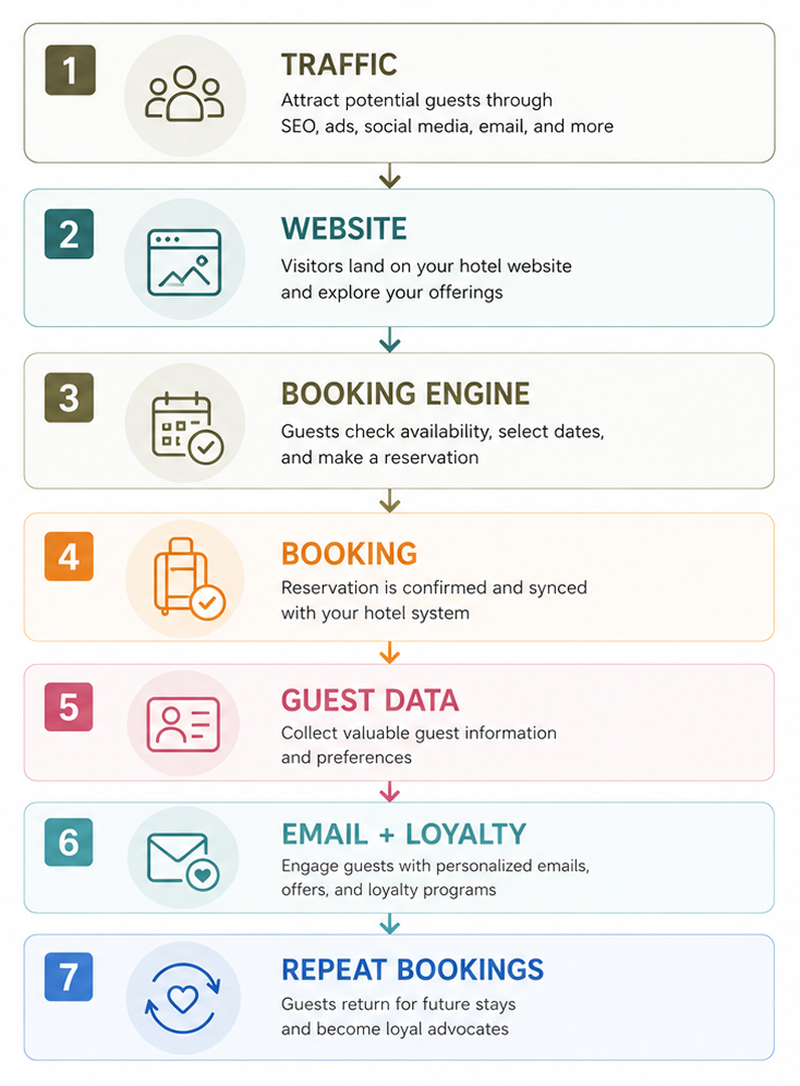
The hotels seeing real growth in direct bookings are combining technology, marketing, and guest experience, not just picking one lane and hoping for the best. Here’s what’s working.
1. Optimize your hotel website for conversions
Your website is your single most important direct booking channel. If it doesn’t perform, nothing else on this list matters.
The basics are non-negotiable: mobile-first design, fast loading speed, high-quality photography, a clear and visible booking call to action, and a booking process that doesn’t ask for more than it needs.
Travelers decide fast. A slow, cluttered, or confusing website hands the booking to an OTA.
Desktop conversion rates for hotel websites sit around 2.9% versus 1.4% on mobile, according to BookingWhizz, despite mobile accounting for 62% of all hotel website visits. That gap is where revenue is being lost.
mention here when discussing the connection between a well-optimized website and direct booking conversion
2. Use a powerful booking engine
Your booking engine is the conversion point for every direct booking. A slow, outdated, or hard-to-use engine is the fastest way to send a motivated traveler back to Booking.com.
The features that move bookings forward include real-time availability, secure payment processing, multi-language and multi-currency support, and a clean mobile interface.
The booking flow should feel effortless. The moment it feels like work, you’ve lost them.
3. Offer exclusive direct booking benefits
If your direct rate is identical to the OTA rate with no added value, there’s no reason for a guest to book direct. Give them one.
The most effective incentives include a small room rate discount for booking direct, a complimentary breakfast, flexible cancellation terms, a room upgrade at check-in, or loyalty points that only accrue on direct stays.
These perks don’t need to be expensive. They need to feel exclusive and be clearly communicated on your website and booking pages.
4. Implement a hotel loyalty program
Loyalty programs are one of the highest-return investments in direct booking strategy. According to Oysterlink, 84% of loyalty members say these programs increase their overall brand loyalty, and members are 70% more likely to choose the same hotel brand over competitors.
A loyalty program doesn’t have to be complex. A points system tied to direct stays, member-only rates, and personalized offers tied to past preferences can build a repeat-booking engine that grows on its own over time.
5. Improve SEO for your hotel website
If travelers can’t find your website through a search engine, your direct booking efforts start at a disadvantage. SEO closes that gap.
The most impactful areas for hotel SEO are local keyword optimization (searches like “boutique hotel in Charleston” or “family resort near Orlando”), a well-maintained Google Business Profile, destination-focused landing pages, and blog content that answers the questions travelers ask before they book.
| SEO area | Goal |
|---|---|
| Local SEO | Capture location searches |
| Google Business Profile | Increase local visibility |
| Destination pages | Target travel intent |
| Blog content | Capture informational searches |
| Technical SEO | Improve UX and conversions |
| Internal linking | Drive users to booking pages |
Travelers searching for something specific are closer to booking. The more precisely your content matches what they’re looking for, the better the traffic quality you attract.
6. Use retargeting ads
Most people who visit your website don’t book on the first visit. Retargeting brings them back. Visitors returning through retargeting ads convert at 2.4 to 4.2%, a significant increase over cold traffic.
Google Ads retargeting and Facebook retargeting campaigns serve ads to people who have already been to your website but didn’t complete a booking. Abandoned booking reminder ads, where someone started filling in dates but stopped, are particularly effective.
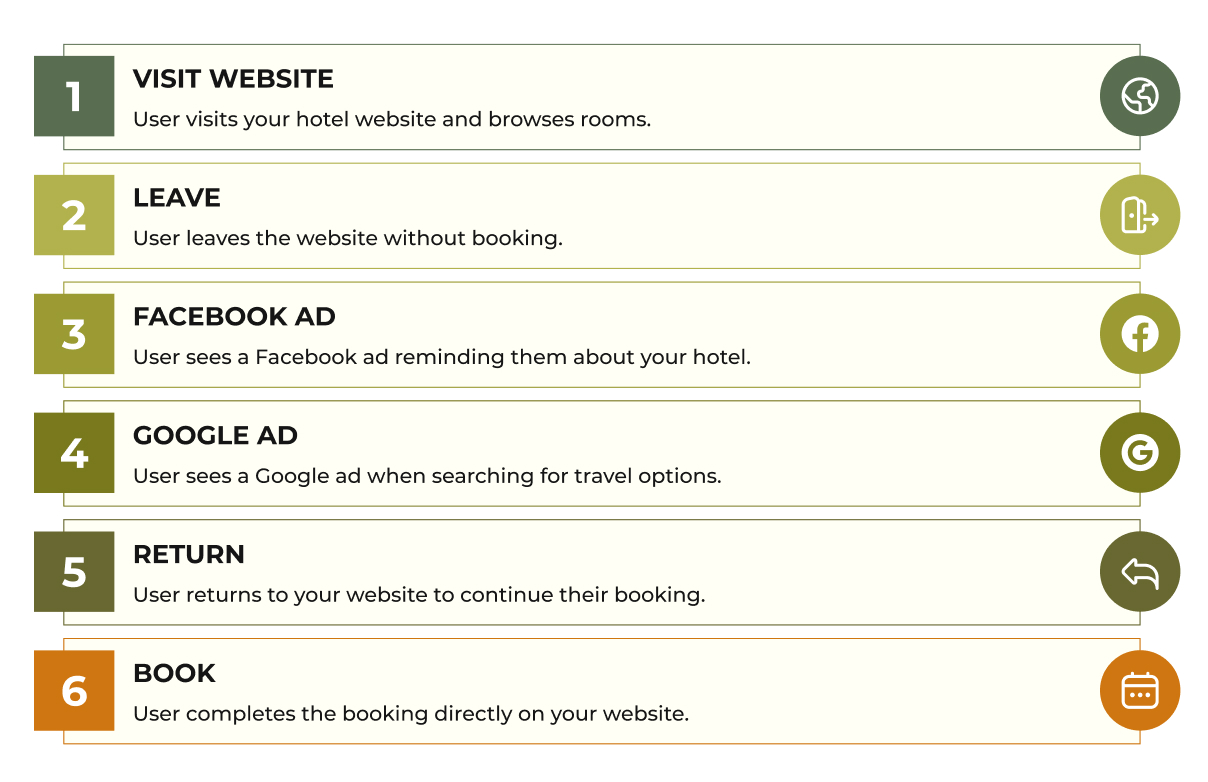
These travelers already showed intent. They just need a nudge.
7. Leverage email marketing
Email is the highest-ROI channel in hospitality marketing. Research consistently shows hotel email campaigns generate around $36 for every $1 spent, outperforming virtually every other channel.
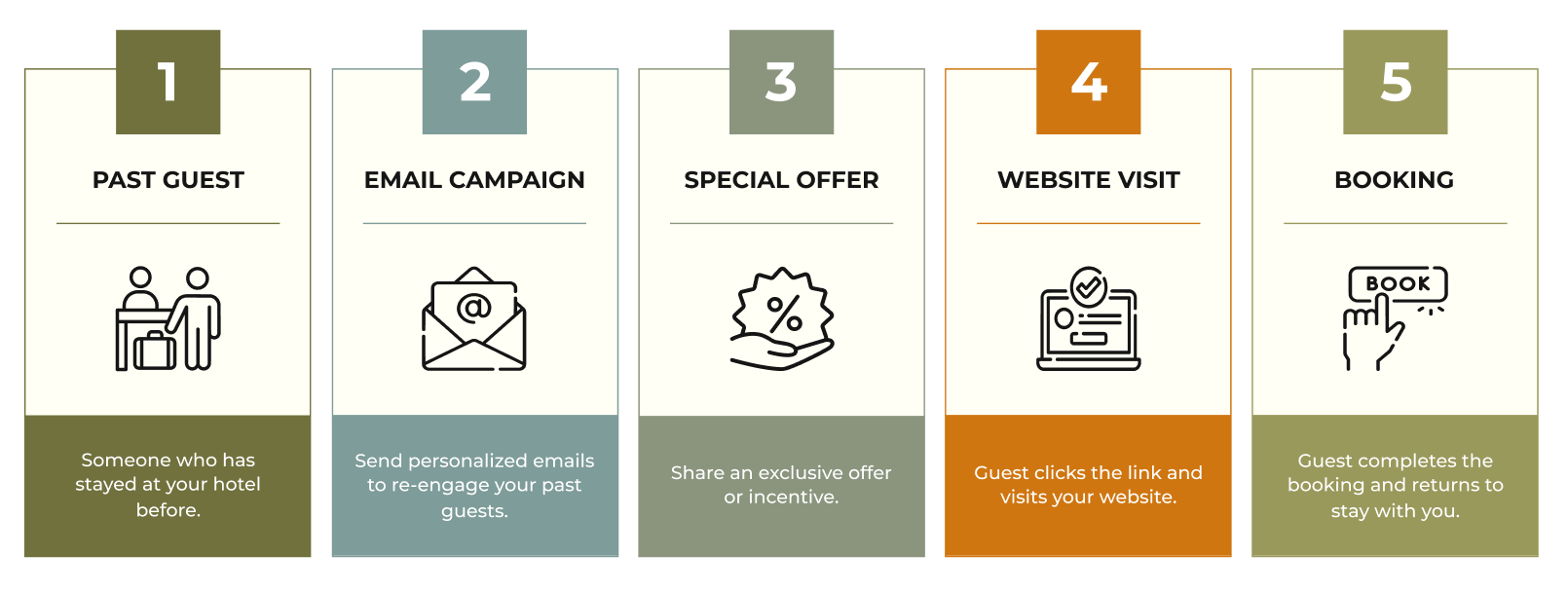
The campaigns that drive direct bookings include pre-arrival emails with upsell offers, seasonal promotions sent to past guests, abandoned booking reminders for people who started but didn’t finish, and loyalty program campaigns that give members a reason to return.
Segmentation is what makes email work. Sending a spa weekend offer to someone who booked a business room last time is wasted budget. Sending a family package offer to a past guest who brought kids is a booking.
8. Promote direct booking on social media
Social media platforms drive awareness and top-of-funnel traffic. Instagram and TikTok are where travelers discover properties they didn’t know existed. Facebook is where they get retargeted and where older demographics spend their browsing time.
The content that performs best is specific and visual: a look inside a room, a morning view from the terrace, a behind-the-scenes clip of what guests experience.
User-generated content from guests is particularly valuable because it signals authenticity without effort from your team.
The direct booking connection comes from linking social content directly to your booking page and running paid campaigns that push traffic to your site rather than an OTA.
9. Showcase guest reviews and testimonials
Reviews are the closest thing to word of mouth at scale. In fact, 93% of travelers consider online reviews before making a booking decision.
Display reviews prominently on your website, especially on the booking page, to reduce hesitation at the moment of decision.
Respond to reviews on Google and Tripadvisor. Integrate your best feedback directly into your homepage. If your hotel has visible, genuine, well-managed reviews, travelers have the social proof they need to complete a booking on your site rather than going back to an OTA to find reassurance.
10. Provide transparent pricing
Hidden fees are one of the fastest ways to lose a direct booking. If a traveler gets to the end of your booking process and sees unexpected charges, they’re gone. And they’re not coming back.
A best rate guarantee, clearly stated and prominently displayed, tells visitors they won’t do better elsewhere. Transparent pricing by room type, with no surprises at checkout, builds trust. And trust is what converts a visitor into a booker.
11. Use personalization technology
Returning guests who are recognized and remembered book again at a much higher rate than those treated as strangers. CRM platforms and booking engine integrations now make it straightforward to flag returning guests and serve them content or offers based on their previous stays.
Personalization doesn’t need to be sophisticated to be effective. Pre-filled booking forms, a room pre-selected based on past preference, or a welcome-back email with a rate specific to their travel history all feel attentive without being intrusive.
12. Create attractive packages and experiences
Packages give travelers a compelling reason to book direct that OTAs can’t easily replicate. Try a romantic getaway with a spa credit, a family weekend with a kids’ activity, or a culinary package with a dinner included.
All of these increase the perceived value of booking directly while protecting your rate positioning.
Make these packages visible and bookable on your website, and promote them through your email list and social channels. Exclusivity is the point: these are offers guests can’t find on Booking.com because they don’t exist there.
How to measure direct booking success
A direct booking strategy without measurement is guesswork. These are the five numbers that tell you whether it’s working.
- Direct booking rate. What percentage of total reservations come through your own channels? This is your baseline and your primary success metric.
- Website conversion rate. How many of your website visitors complete a booking? Below 1.5% for independent hotels is a signal that the website or booking engine needs attention.
- Cost per acquisition (CPA). What does each direct booking actually cost you in marketing spend? Compare this against what an OTA booking would have cost in commission.
- Average booking value. Are your direct guests booking higher-value rooms and longer stays? They should be. If not, your booking engine or landing pages may be steering them wrong.
- Repeat guest percentage. How many guests come back? Repeat direct bookers are your most profitable guests, with low acquisition cost and high lifetime value.
Track these monthly. Decisions made from real data are faster, cheaper, and more effective than those made from instinct. If your direct booking rate improves by five percentage points over a year, run the math on what that means in actual revenue.
| KPI | Good benchmark |
|---|---|
| Direct booking rate | 30–50%+ |
| Website conversion rate | 2–4% |
| Mobile conversion rate | 1–2% |
| Average booking value | Growing YoY |
| Repeat guest rate | Growing YoY |
| CPA | Lower than OTA commission |
The number is usually motivating.
The future of hotel direct bookings
The trajectory is moving in a favorable direction. Skift Research projects direct digital hotel channels will overtake OTAs by 2030, reaching over $400 billion in gross bookings compared to $333 billion from OTAs.
The forces driving that shift are already visible today. AI-driven personalization is making it possible for hotels of all sizes to deliver the kind of tailored experience that used to require a large, expensive CRM operation.
Voice search and conversational booking are changing how travelers initiate reservations, and properties whose content is structured to answer direct questions will have an advantage.
Mobile-first booking experiences are the norm, not a feature. Travelers expect your website to be as easy to navigate on a phone as it is on a laptop.
The properties that have invested in this are already seeing it in their conversion rates.
Data-driven marketing automation is closing the gap between what large chains can do and what independent hotels can now access through affordable platforms.
The tools exist. The question is whether you’re using them.
Hotels that invest consistently in their direct booking infrastructure (website, booking engine, loyalty program, and email marketing and SEO) will be positioned to capture a growing share of a growing market.
Those that keep farming out bookings to OTAs will find the commission burden getting harder to absorb as competition increases.
How to increase direct bookings for your hotel
Direct bookings are the most profitable bookings your hotel takes. They eliminate commissions, build guest relationships, and give you data that compounds in value over time.
Getting there takes a combination of things: a website that converts, a booking engine that doesn’t frustrate people, meaningful perks for direct bookers, a loyalty program that rewards return visits, and marketing that consistently brings guests to your pages instead of an OTA’s.
None of this happens overnight. The hotels winning at direct bookings have been investing in this infrastructure steadily, adjusting what isn’t working, and building on what is. Start with the highest-impact items: your website and booking engine. Then work outward from there.
Every tactic in this guide is something you can start on today. If you’d rather have a specialist team handle it, our hospitality marketing services are built specifically for hospitality businesses that want more direct bookings and less OTA dependence.
What’s the biggest obstacle stopping your hotel from growing direct bookings right now?