

Andy Zenkevich is the Founder and CEO of Epiic, a hospitality marketing agency helping boutique hotels and experiential stays grow direct bookings through data-driven marketing, SEO, content, and operational strategy.
Your hotel shows up beautifully on the inside. The rooms are ready, the reviews are solid, and the location is genuinely great.
The problem? When someone types “hotel near [your city]” into Google or AI search right now, your property doesn’t make it into the top results. Not even close.You’re not alone in this. Research shows that close to 50% of consumers add “near me” to their local searches. The majority of that traffic lands on whoever ranks in the Local Map Pack. Everyone else fights over what’s left.
Most hotel owners put real energy into the property itself and treat local digital presence as an afterthought. Local SEO for hotels rarely gets the attention it deserves, and that gap quietly costs real bookings every single week.
This guide covers the full picture. What local SEO is, why it matters so directly to your bottom line, a step-by-step strategy you can start acting on today, and the mistakes most hotels keep repeating without realizing it.
Read on and you’ll have a plan.
Key takeaways
- Local SEO for hotels is about geographic search intent, not broad organic rankings.
- Your Google Business Profile is the most powerful local signal you directly control.
- Reviews, NAP consistency, and localized content are the three pillars every hotel needs.
- Most properties start seeing meaningful traction from local SEO within five to six months.
- Strong local visibility leads to more direct bookings and less reliance on OTAs.
What is local SEO for hotels?
Local SEO for hotels is the process of optimizing your hotel’s online presence so it appears when travelers search for accommodations in a specific area.
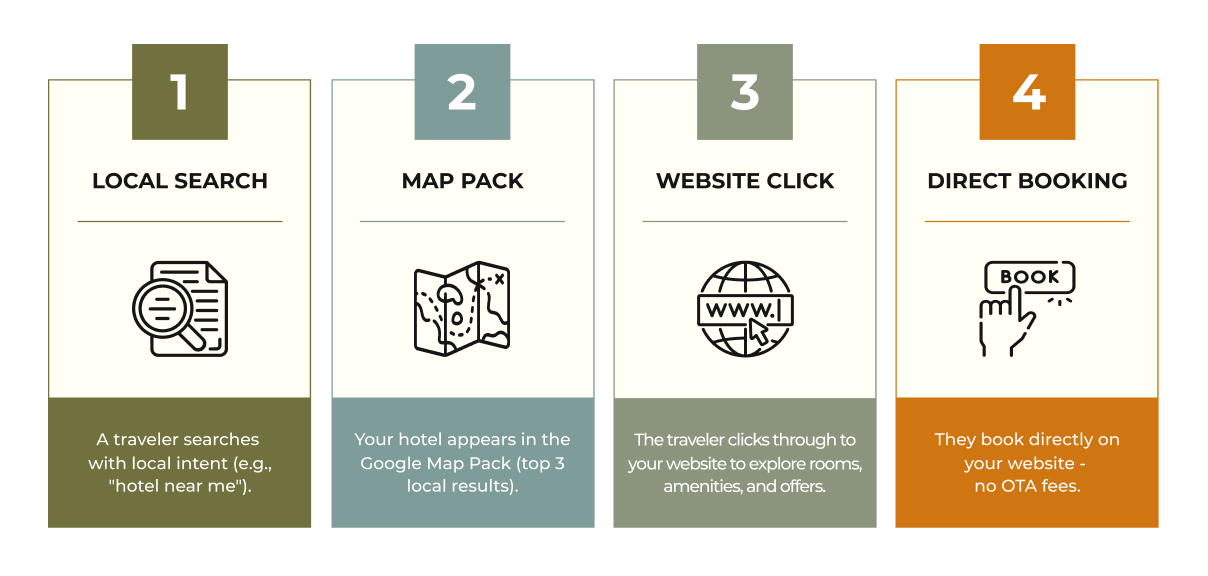
The goal is straightforward: show up in Google Maps, the Local Pack (the top three results with the map pins), and localized organic results when someone searches “boutique hotel in Austin” or “family hotel near Universal Studios.”
This is different from traditional SEO for hotels. Traditional SEO chases broad, national, or global rankings. Local SEO zeroes in on geographic intent, putting your property in front of people who are already planning to stay somewhere near you. The intent is far more specific, and the searcher is far closer to booking.
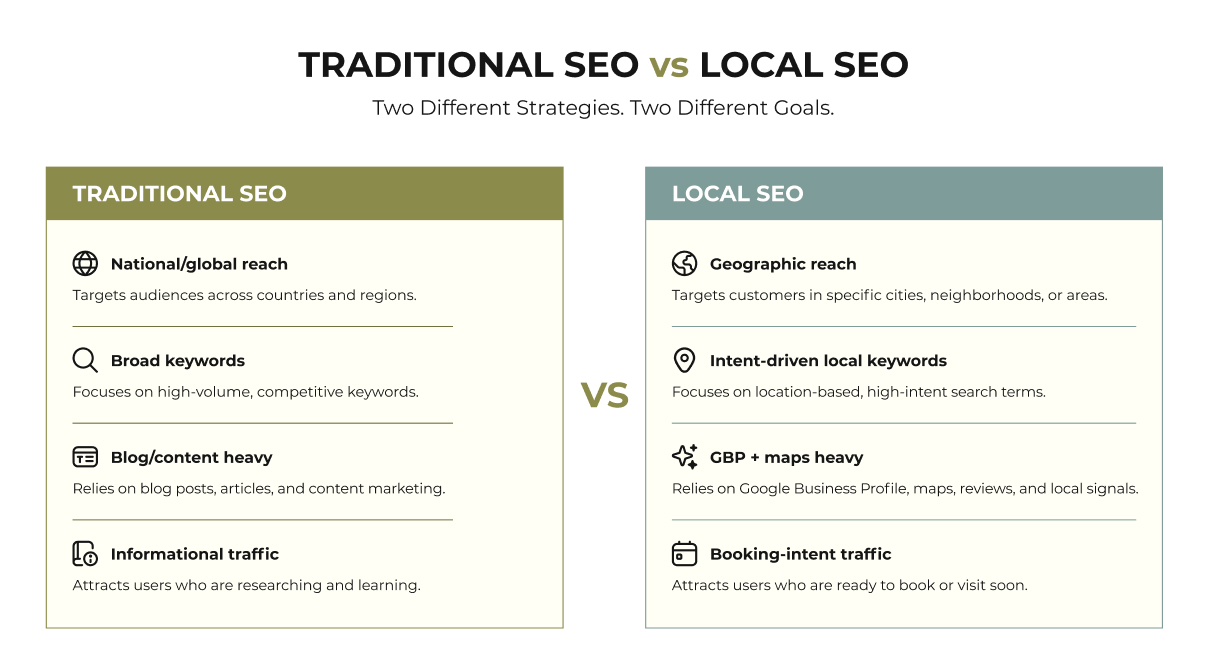
At the center of all of it is your Google Business Profile. This is the listing that feeds Google Maps and the Local Pack. Without a well-maintained profile, your hotel is effectively invisible in local search, no matter how good your website is.
Hotels are uniquely dependent on local search because every booking decision is location-driven by definition. The question is never, “Should I care about local search?” It’s always “Am I showing up when it counts?”
Why local SEO matters for the hospitality industry
Here’s something worth sitting with for a moment.
Recent data shows that 98% of consumers used the internet to find a local business in 2026, with 21% doing so every single day. For hotels, that search happens at high commercial intent. Someone searching “hotel near me” isn’t browsing. They’re ready to book.
The Map Pack captures a disproportionate share of that traffic. A listing that lands in the top three local results gets the lion’s share of clicks. Everything outside that window competes for far less.
Strong local SEO also reduces OTA dependency. Every traveler who finds your property through Google Maps and books directly is a reservation that avoids third-party commission. See how local visibility supports a broader strategy for increasing direct hotel bookings.
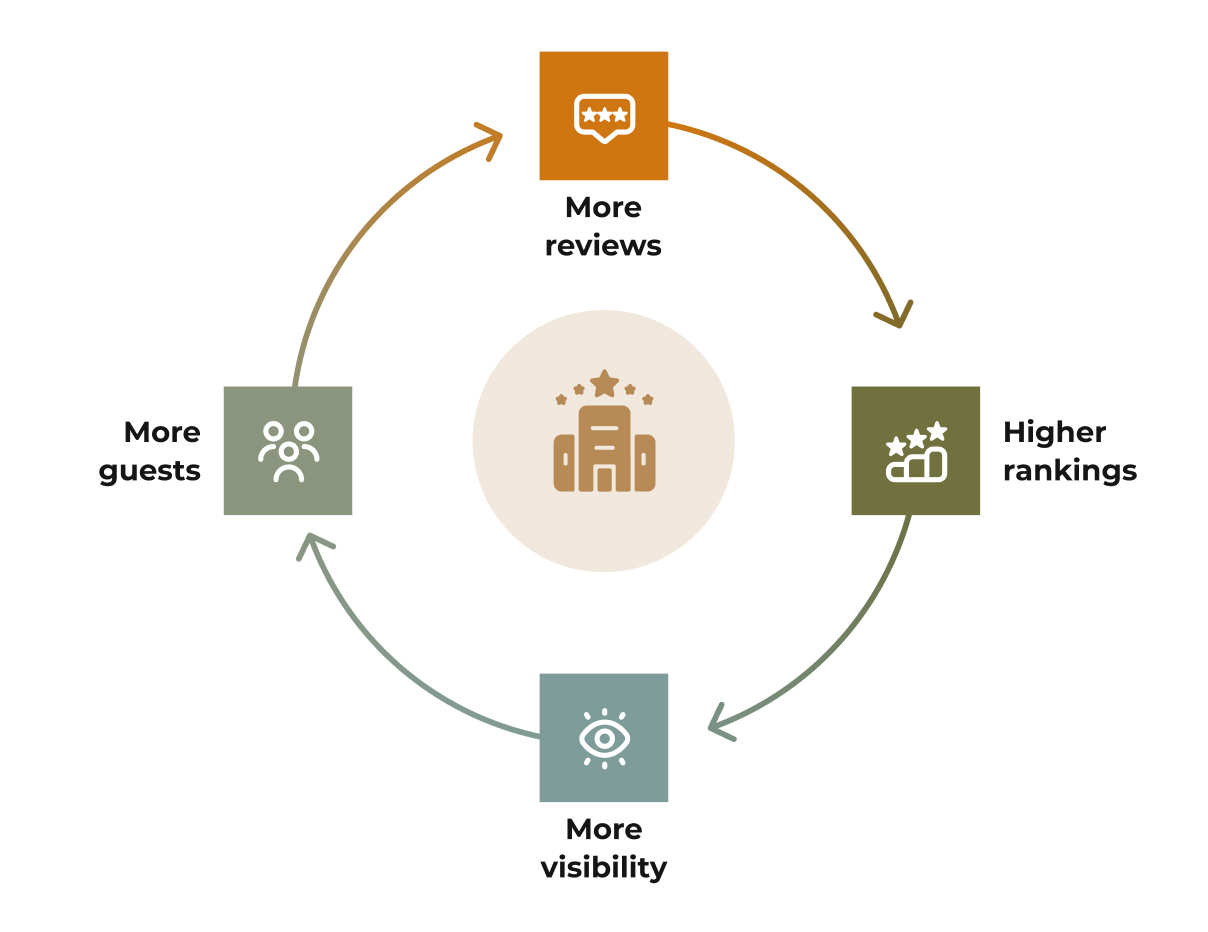
Reviews are woven into all of this. Statistics show that 94% of travelers say a negative review has convinced them to avoid a business. The inverse is true too. A consistent stream of positive reviews lifts your local ranking, which brings in more guests, who leave more reviews.
That cycle works in your favor once it’s running. Why?
Because local visibility is where the bookings actually live. Not somewhere abstract. Right there, in the Map Pack, every time someone searches.
Core ranking factors for hotel local SEO
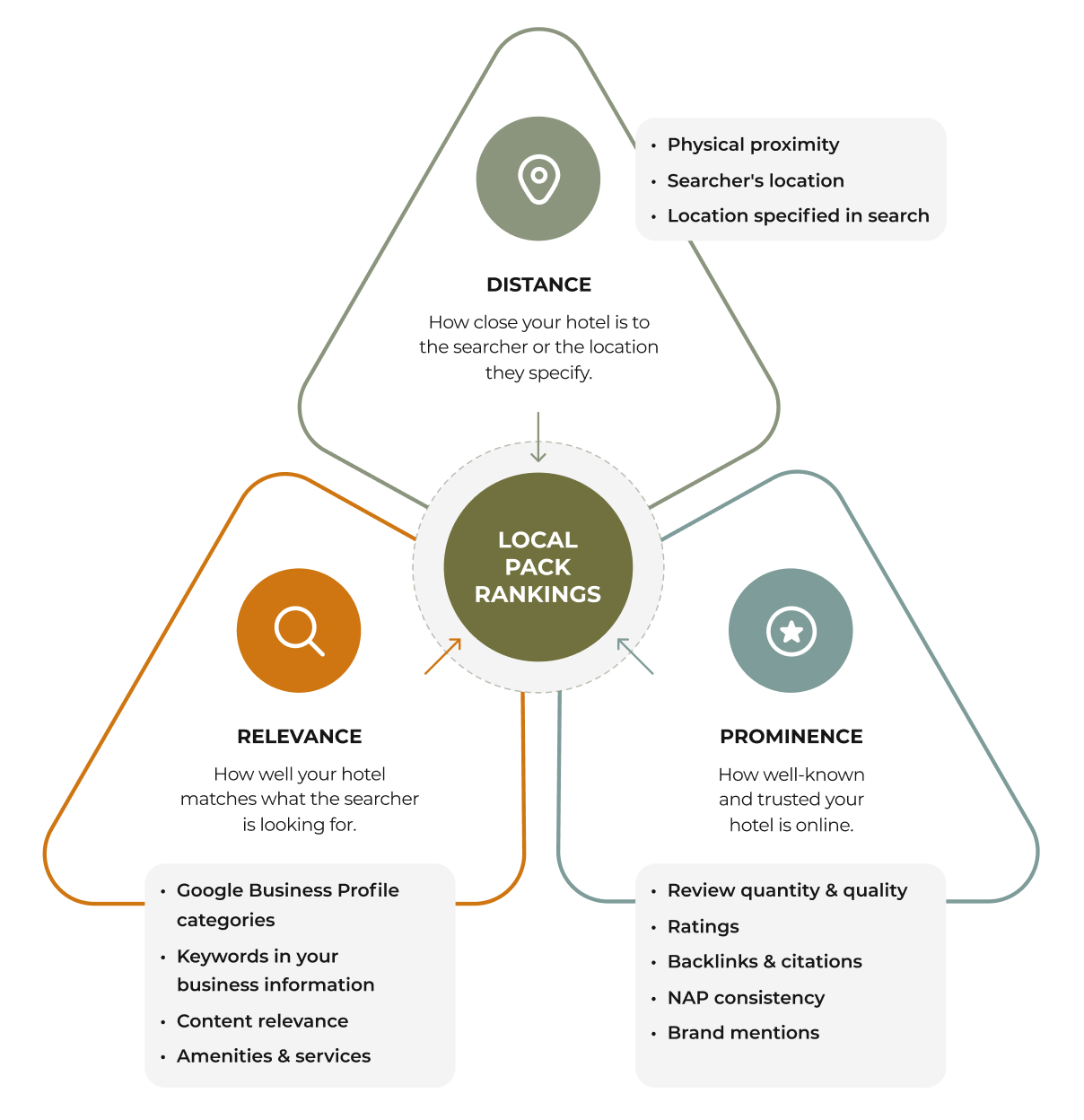
Google uses three primary signals to decide which hotels appear in the Local Pack. Knowing these helps you put effort in the right places.
Relevance
Relevance is about how closely your listing matches the search query. Google looks at your Google Business Profile category, the keywords in your description, and how well your website content aligns with what the traveler typed. Selecting the most accurate category, “hotel,” rather than something vague, makes a real difference here.
Distance
Distance is exactly what it sounds like. Google factors in how close your property is to the searcher or the location they specified.
You can’t move your hotel. But you can make sure your address and map pin are accurate. A wrong pin placement or a missing suite number can quietly reduce your local visibility.
Prominence
Prominence reflects how well-known and credible Google considers your property to be. This includes:
- The quantity and quality of your reviews
- The number and authority of backlinks pointing to your website
- Your brand mentions across the web
- How consistent your business information is across directories
Hotels with a strong, well-maintained online reputation consistently outrank properties that keep a minimal digital footprint.
Work on all three, not just one. Each one reinforces the others.
Step-by-step local SEO strategy for hotels
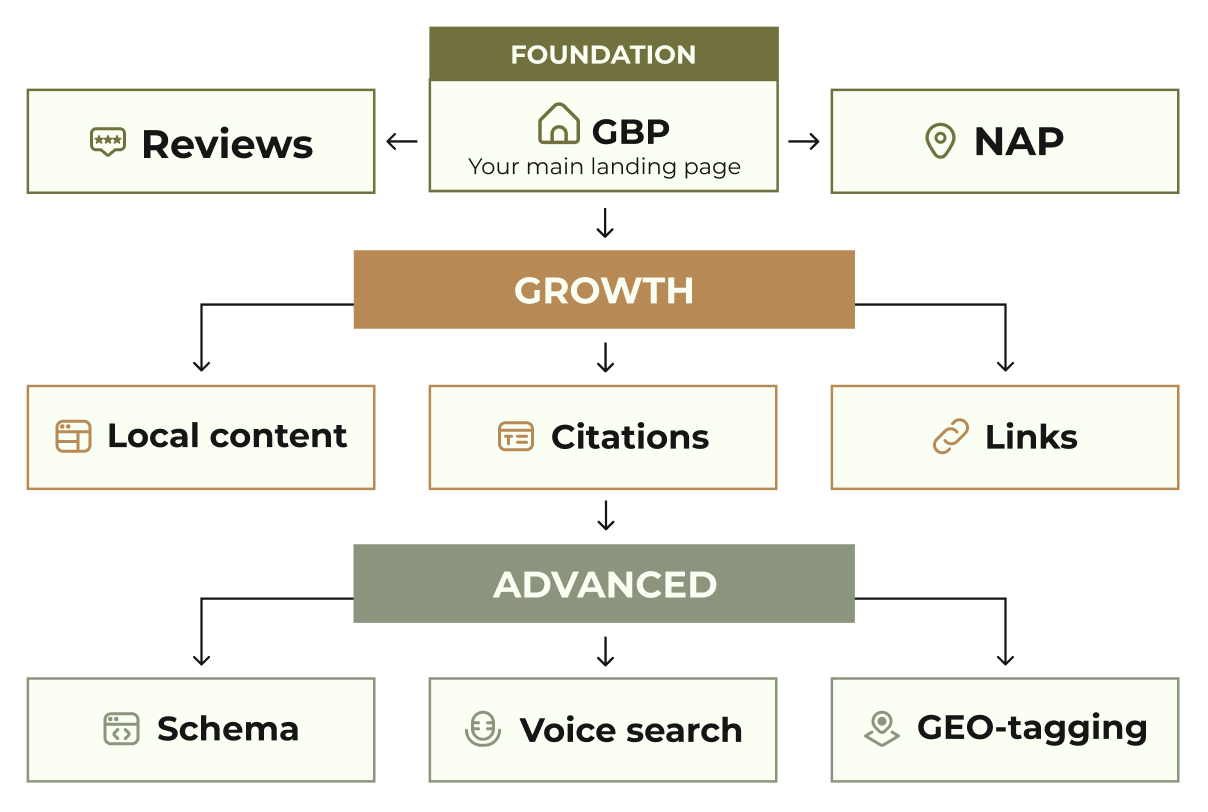
This is the part that actually moves things. A solid hotel local SEO strategy isn’t one big action. It’s five focused areas, each one building on the last. Here’s how to approach them.
1. Optimize your Google Business Profile to drive more local visibility
Your Google Business Profile (GBP) is your most powerful local SEO asset, and it costs nothing to use.
Start with the basics. Select “hotel” as your primary category. Fill in your NAP (name, address, phone number) completely and accurately. Upload high-quality photos of your rooms, exterior, lobby, pool, and amenities. Travelers make instant judgments from photos, so treat your GBP gallery like a first impression.
Fill out every field in the amenities section: Wi-Fi, parking, breakfast, pet-friendly rooms, accessible facilities. Each entry is a keyword signal telling Google what your property offers and who it’s right for.
Publish regular Google Posts. These are short updates that appear directly on your listing. Use them for seasonal offers, local events you’re hosting, or a simple update about what’s new at the property. Regular activity signals to Google that your listing is actively maintained.
2. Build and manage hotel reviews to win more direct bookings
Reviews are one of the strongest local ranking signals in hotel local SEO. Not just the star rating. Volume, recency, and how you respond all factor in.
Review freshness carries real weight. A hotel with 300 reviews that stopped arriving a year ago can be outranked by one with 90 reviews that keep coming in consistently right now.
As such, encourage guests to leave feedback post-stay. A simple follow-up email the day after checkout, a QR code card in the room, or a friendly mention during checkout all work. Keep it ethical. Don’t offer incentives. Just ask genuinely.
Respond to every review. Positive, negative, and everything in between. Your response tells future guests that a real person is running this property and that you take their experience seriously.
3. Optimize location pages on your website to capture local search traffic
Your website needs to speak the language of local search clearly and specifically.
Use relevant location-based travel keywords, such as “hotel in [city],” “[city] boutique hotel,” and searches connected with nearby landmarks or neighborhoods, naturally in your location page copy. Reference nearby landmarks and attractions that travelers actually search for: “two blocks from Millennium Park” or “walking distance from the waterfront.”
Embed a Google Map on your contact or location page. This adds a geographic signal and makes the page more useful for real visitors.
Add hotel schema markup using schema.org. This structured data tells Google precisely what your pages contain: room types, price range, check-in times, amenities. Most hotels skip this step entirely. Doing it now gives you an immediate advantage.
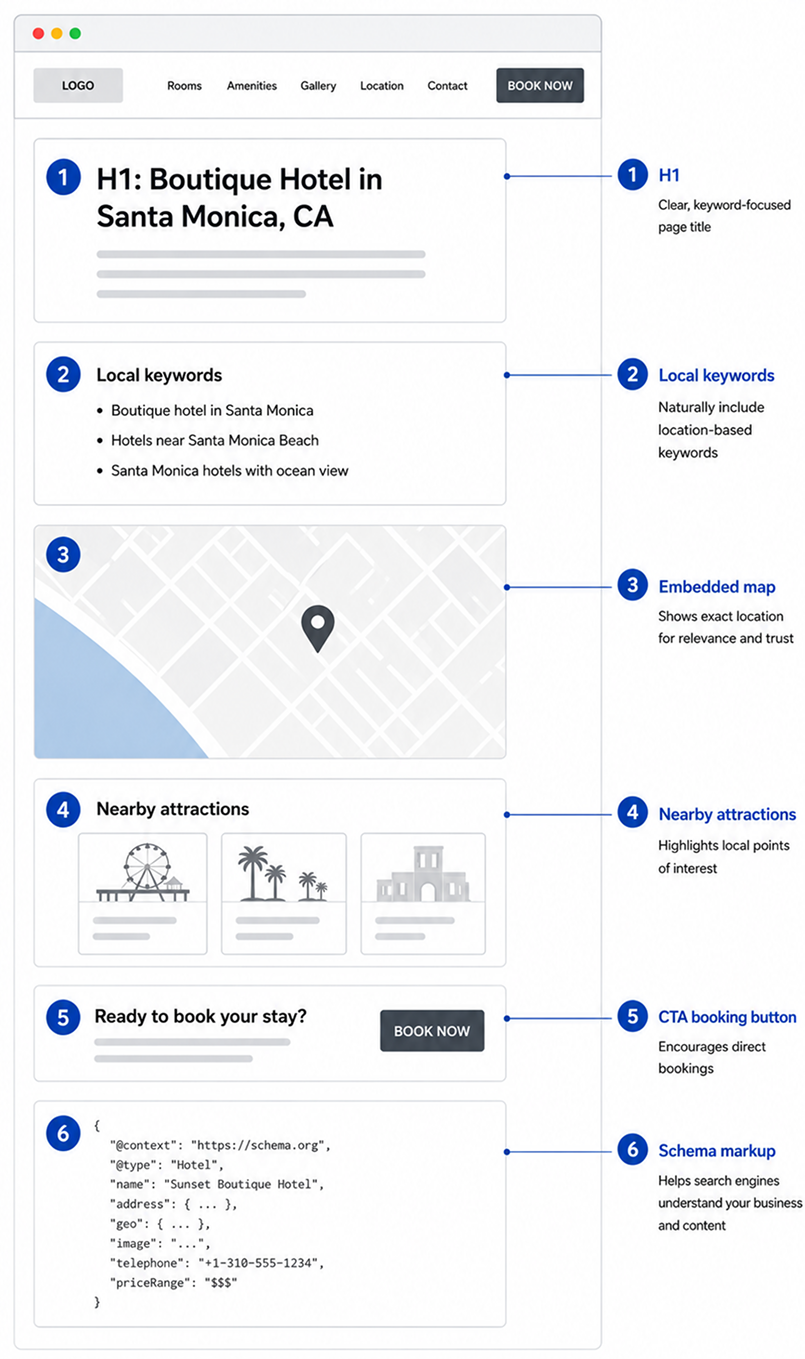
Make sure the page loads fast on mobile. According to Statista, mobile devices account for over 52% of global web traffic. If your location page is slow on a phone, you’re losing guests who were already looking at your property.
On-page SEO best practices for hotel websites covers the full technical checklist for getting this right.
4. Build local citations and listings to strengthen your local SEO presence
A citation is any online mention of your hotel’s name, address, and phone number. The more consistent these are across the web, the more confident Google becomes about your property’s legitimacy.
Start with the major platforms: Booking.com, Expedia, TripAdvisor, Google Business Profile, and Yelp. Make sure the information is identical everywhere. Not similar. Identical.
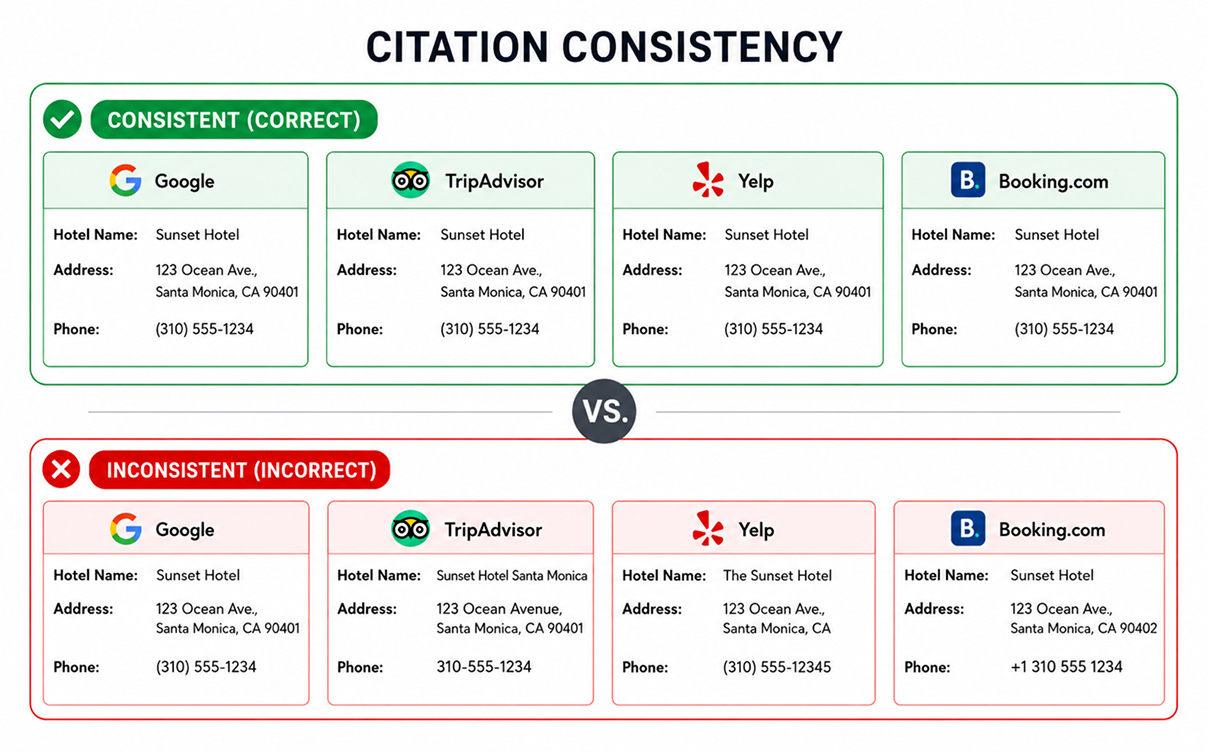
Submit your property to local directories and tourism board websites. If your city or region has a visitors bureau or destination marketing organization, get listed there. These are high-authority local sources Google pays attention to.
Run a citation audit at least twice a year. Tools like BrightLocal or Moz Local scan for inconsistencies across hundreds of directories and flag the ones that need fixing.
5. Create localized content that brings travelers to you before they even search for hotels
This is where most hotels leave traffic on the table.
Localized content means pages and blog posts that answer questions travelers are asking before they decide where to stay. “Best things to do near the Nashville waterfront,” “Weekend guide to Charleston SC,” “Festivals near San Antonio River Walk in October.”
These pages target searchers planning a trip to your area, not yet sure where to stay. They find your guide. They read it. Your property is naturally woven throughout. By the time they’re ready to book, you’re already familiar to them.
Build neighborhood pages, seasonal travel guides, and local event roundups. Keep them genuinely useful, not just promotional. The more real value they deliver, the more Google sends people their way.
Advanced local SEO tips for hotels that want to go further
Once the fundamentals are running, these are the moves that separate the top-ranking properties from the rest:
- Local link building: Reach out to local media, neighborhood blogs, tourism publications, and event organizers. A mention or link from a respected local source carries lots of weight in hotel local SEO. Sponsor a community event. Partner with a nearby restaurant for a “stay and dine” package and ask for a link back to your site.
- Advanced structured data: Beyond basic hotel schema, add FAQ schema, Review schema, and Local Business schema. Each type gives Google more precise signals about your property and increases your chances of appearing in rich results.
- Voice search optimization: Smart speaker and voice queries are increasingly common in travel planning. These searches tend to be conversational: “What’s the best family hotel near downtown San Francisco?” Structure pages around complete, direct answers to questions phrased this way.
- Image geotagging: Adding location metadata to your property photos is a modern local signal most hotels ignore completely. It’s a small step, and in a competitive local market, small edges stack up.
Map Pack rankings monitoring: Use a tool like BrightLocal or Local Falcon to track where your property appears in local results across different search locations. Rankings shift based on where the searcher is physically standing. Knowing this helps you spot and close gaps.
Common local SEO mistakes hotels should avoid
Most of these come up repeatedly. This means fixing them gives you an immediate leg up on the properties still making them.
- Inconsistent NAP across platforms: “Hotel XYZ LLC” on your website and “Hotel XYZ” on TripAdvisor are not the same thing to Google’s systems.
- Ignoring guest reviews: No response to reviews looks like no one is home.
- Duplicate Google Business Profiles: These split your reviews and create conflicting signals. If you have duplicates, merge or remove them now.
- Thin location pages: A 200-word page with your address and a contact form is not a location page. It’s a placeholder.
- Poor mobile optimization: If your site takes more than 3 seconds to load on a phone, most visitors are already gone before they see your rooms.
- Overreliance on OTAs: Letting Booking.com and Expedia carry all your distribution while neglecting your own local presence is a margin problem dressed up as a strategy.
How long does local SEO take for hotels?
Fair question, and the straight answer is: it depends. But five to six months is a realistic window to see meaningful traction.
Here’s what affects that timeline:
- Competition level: A boutique property in a smaller city with limited local competition will move faster than a hotel in a city-center market full of large chains and well-established listings.
- Review velocity: Hotels that collect reviews consistently tend to see local ranking improvements faster than those sitting on a flat review count from two years ago.
- Website and brand authority: If your website is relatively new or has had little SEO attention, it takes Google longer to build confidence in it. Older, more authoritative domains respond faster.
The key word across all of this is consistency. Local SEO for hotels is not a one-time campaign. It’s an ongoing commitment to maintaining your presence, content, and reputation across every platform where travelers find you.
Short-term wins are possible, especially with a fully optimized GBP and a fresh wave of reviews. Compounding, sustainable growth takes longer. Start now, stay consistent, and the results build on themselves.
Conclusion
Local SEO for hotels is not a puzzle reserved for marketing specialists. It’s a practical set of habits:
- Keeping your Google Business Profile accurate and active
- Collecting reviews consistently
- Building location-specific content
- Making sure your information is correct everywhere it appears
The hotels winning in local search right now are not always the biggest or the best-funded. They’re the ones that showed up and kept showing up.
Your local visibility is something you can genuinely control. Start with the fundamentals in this guide. Work through each step. Then layer in the advanced tactics as confidence grows.
Every tactic in this guide is something you can start on today. If you’d rather have a specialist team handle it, our hotel SEO services are built specifically for hospitality businesses that want more direct bookings and less OTA dependence.
What’s your biggest challenge with local SEO right now? Is it reviews, the GBP setup, or something else entirely? Drop it in the comments below.