
Andy Zenkevich is the Founder and CEO of Epiic, a hospitality marketing agency helping boutique hotels and experiential stays grow direct bookings through data-driven marketing, SEO, content, and operational strategy.
Here’s something that might sting a little.
You’ve put real money into your hotel website. The photos look great. The booking engine works. Maybe you even did a redesign last year. And yet, when someone types “boutique hotel in [your city]” into Google, Booking.com shows up. Expedia shows up. Your website? Page two, if you’re lucky.
You’re not alone in that. Independent hotels have been fighting this battle for years. And the honest truth is that most of them are losing it, not because their properties aren’t great, but because their websites aren’t pulling their weight.
That’s what hotel SEO is for.
This guide is written for independent hotel owners, hotel groups, and the marketers and revenue managers behind them. We’ll walk through everything: how travelers search, what local signals actually move the needle, and what content captures guests long before they’re ready to book. No jargon. Nothing you need a computer science degree to act on.
Let’s get into it.
Key takeaways
- Hotel SEO is about direct bookings and brand independence, not just traffic numbers.
- Local SEO is the most important piece for independent and boutique properties.
- Keyword research should follow booking intent, not just search volume.
- Your technical setup, speed, mobile experience, and schema is the foundation everything else builds on.
- Content marketing reaches guests at stages your booking pages simply cannot.
- Watching branded vs. non-branded traffic growth tells you if your SEO is actually working.
What is hotel SEO and why it matters for the hotel industry
Hotel SEO is a marketing strategy that aims to improve your hotel website’s ranking on search engines like Google, thus building your digital presence. What you’ll see are organic search results that you earn over time and own outright. Not through ads nor OTA listings.
That’s a different goal from generic SEO, which focuses on visibility for any audience. Hotel SEO sits at the intersection of local search, travel intent, and content that moves people toward a booking decision.
Why does it matter?
Because OTA commissions are genuinely painful. OTA commission rates typically run between 15% and 30% of the booking value. Some properties pay even more when visibility programs and promotional fees are included.
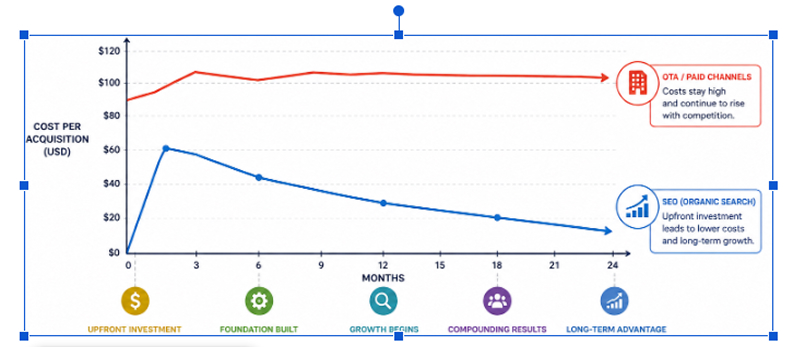
Organic search also works differently from paid channels. Paid ads stop the moment you stop spending. SEO for hotel websites builds authority over time, compounds, and keeps generating bookings long after the initial investment. For hotels looking to reduce OTA dependency, that compounding effect is the real prize.
Real searches happening right now:
- “hotel in chicago near the riverwalk”
- “pet friendly hotel savannah ga”
- “boutique hotel new york”
- “hotel near orlando airport with free shuttle”
Behind each one of those searches is a traveler with a credit card and a specific need. Hotel SEO is how you show up when they type it.
How travelers search for hotels online
Getting a feel for how travelers search is the foundation of any hotel SEO campaign. Not every search carries the same intent, and matching your content to the right intent type is what separates pages that rank from pages that sit quietly on page three.
There are four intent types worth knowing:
- Informational: “best time to visit Nashville” or “things to do in Miami Beach.” The traveler is in inspiration mode. They’re not booking yet, but they can absolutely be influenced right now.
- Commercial: “best boutique hotels in Charleston” or “hotel with rooftop pool NYC.” They’re narrowing down options. Category pages and blog content do the heavy lifting here.
- Transactional: “book hotel room downtown Denver” or “hotel deals Chicago this weekend.” Ready to book. If your website isn’t visible here, you’re handing that booking to someone else.
Local: “hotel near me” or “hotel near Times Square.” Often the highest-converting searches of all.
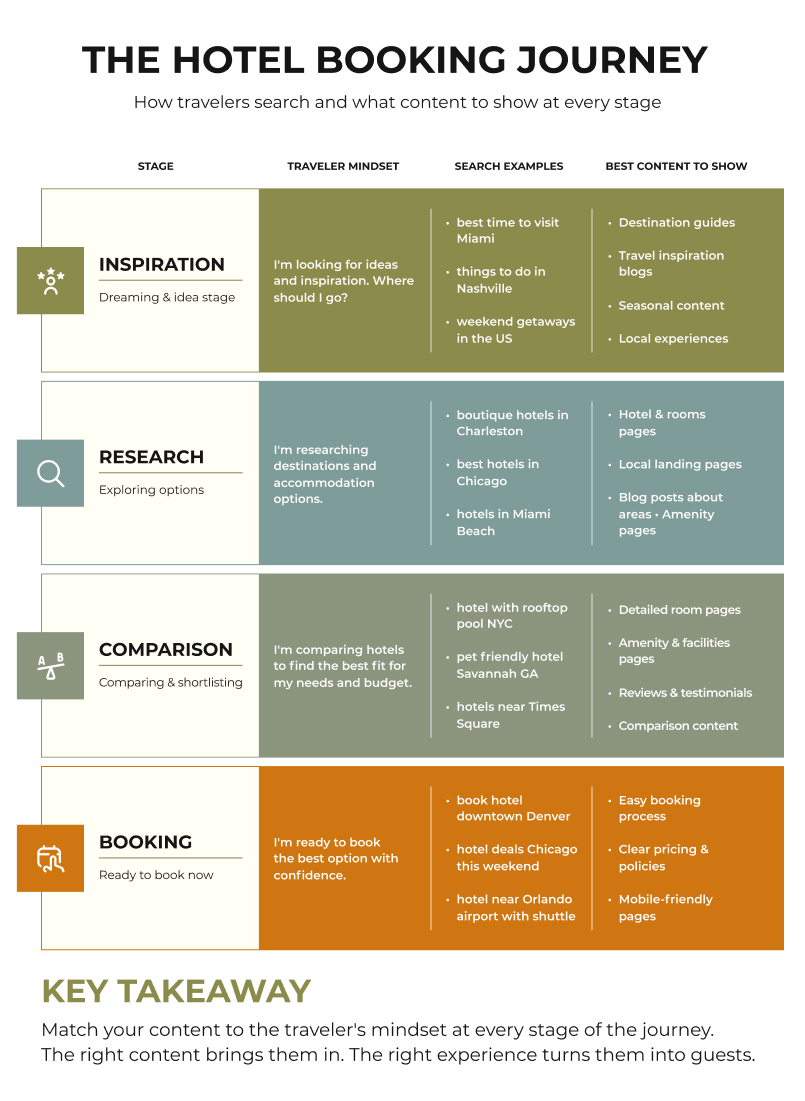
The typical booking journey moves from inspiration to research to comparison to reservation. Each stage needs different content. A destination guide gets you in front of travelers early. A detailed, specific room page closes them later.
Brand searches, where someone types your hotel’s name directly, tell you about awareness you’ve already built. Non-brand searches are how you win guests who don’t know you yet. Destination-based searches, which include city names, neighborhoods, and nearby landmarks, are where most of the keyword volume sits in hotel SEO.
Map those three categories to the booking journey, and you’ve got the foundation of your keyword strategy.
Keyword research for hotel SEO
Most hotel websites target keywords based on what sounds right. But that’s not a strategy. That’s guessing.
Good keyword research for hotel SEO starts with booking intent, not search volume.
Four core categories to work through:
- Brand keywords: Your hotel name and common variations. These protect your direct traffic and make sure you own your name in search.
- Location-based keywords: “Hotel near the French Quarter” and “hotel in downtown Seattle” pull in high-intent travelers consistently.
- Amenity-based keywords: “Pet-friendly hotel,” “hotel with pool,” “hotel with free parking.” These attract guests who know exactly what they need.
- Experience-based keywords: “Luxury boutique hotel,” “family-friendly resort,” “romantic weekend getaway.” These take longer to convert but build demand at the inspiration stage.
Keyword intent matrix
| Keyword type | Example | Competition | Conversion potential |
|---|---|---|---|
| Brand | Hilton Chicago | Low | Very high |
| Local | hotel near Navy Pier | Medium | High |
| Amenity | hotel with spa Chicago | Medium | High |
| Experience | best areas to stay in Chicago | Low | Low |
When prioritizing, look at two things: intent and conversion potential. “Hotel near Miami airport” converts far faster than “best hotels in Florida.” Both have value, but they belong at different points in your strategy.
Long-tail keywords deserve lots of attention in hospitality SEO. Searches like “pet-friendly hotel in Savannah with outdoor space” are less competitive and highly specific and come from travelers who are close to booking. Ahrefs’ keyword data shows that 95% of all keywords receive fewer than 10 monthly searches. That’s the long tail. And it’s where a lot of hotel SEO wins are hiding.
Tools that work well here: Google Search Console, Google Keyword Planner, Ahrefs, and Semrush. Combine those with your own booking data. It tells you which room types and amenities actually drive revenue, not just clicks.
On-page SEO for hotel websites
On-page SEO is where strategy meets execution. It’s the work of structuring your pages so both search engines and real travelers can quickly figure out what you offer and why your property is worth booking.
Title tags, meta descriptions, and headers are the basics. Your title tag is the clickable headline in search results, and your meta description is the summary below it. Together, they decide whether someone clicks your listing or the one above it. Keep them specific and benefit-driven, with your location and key differentiator front and center. Headers (H1, H2, H3) then structure the page so Google knows what it’s about before it reads a word of content. One H1 per page, keywords in H2s. Natural language throughout.
Then there’s mobile design, which is not optional. More than 60% of hotel searches happen on a smartphone, and Google ranks your site based primarily on how it performs on mobile. That means pages need to load fast, text needs to be readable without zooming, and your booking flow needs to work without friction on a 6-inch screen. A guest who can’t book on their phone in under 2 minutes is a guest who books somewhere else.
Here are the pages that drive the most significant results in on-page SEO for hotel websites:
- Room pages: Specific, descriptive, and built around what makes each room worth booking
- Amenity pages: Stand-alone pages for your spa, restaurant, pool, or parking that target amenity-specific searches directly
- Special offers and packages: Pages targeting transactional searches from travelers actively looking for deals
A couple of additional tweaks that are easy to overlook: internal linking and image optimization. Link your room pages to amenities, your blog to your booking page, and your location content to the most relevant rooms. Every internal link passes SEO authority and nudges travelers one step closer to booking.
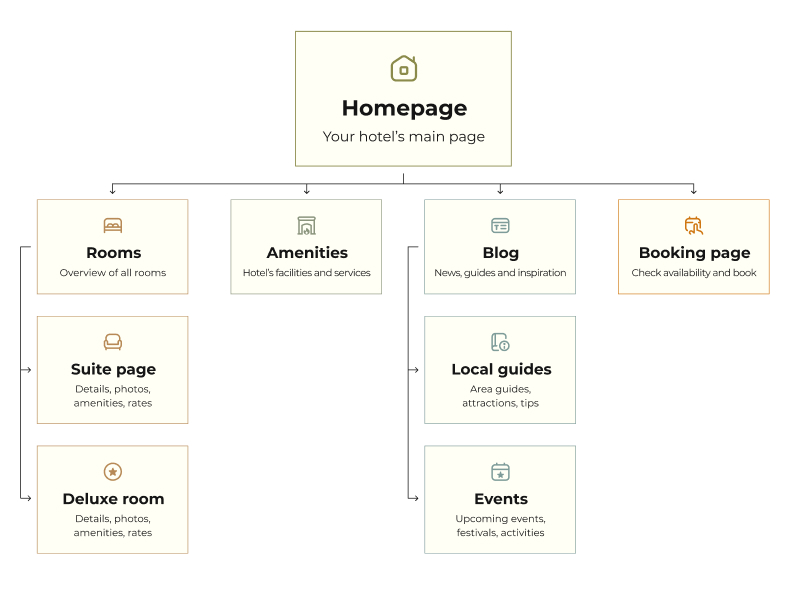
For images, rename files descriptively (think “ocean-view-suite-miami-beach.jpg” instead of “IMG_003.jpg”). Write accurate alt text for every shot, and compress everything before upload. Uncompressed images are one of the fastest ways to undo every other on-page improvement you’ve made.
We’ve put together a full step-by-step guide to on-page SEO for hotel websites. It covers heading structure, metadata, image SEO, and schema markup in detail, with real examples you can act on today.
Local SEO for hotels
Local SEO is the single most important piece of hospitality SEO for most independent properties. Hotels are destination businesses. Travelers search for accommodation in a specific place, and local SEO is how you show up in that search.
Your Google Business Profile is where it starts. This listing appears on Google Maps and the local pack at the top of search results. If your profile is incomplete or inaccurate, you’ve already lost a traveler even before they reach your website.
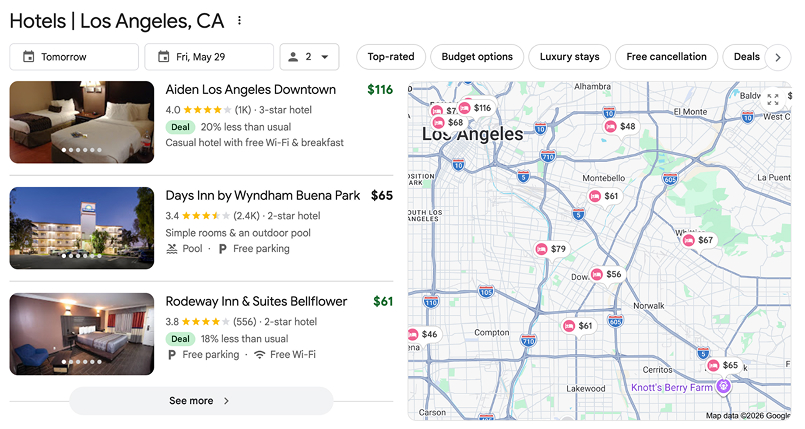
Get these right on your profile:
- Pick accurate primary and secondary categories.
- Upload high-quality photos of rooms, lobby, amenities, and exterior.
- Post regular updates and seasonal offers.
- Keep your hours, address, and contact information current.
NAP (name, address, and phone number) consistency matters more than most people realize. These details need to be identical everywhere your property appears online. Your website, Google Business Profile, TripAdvisor, Booking.com, Yelp, every directory. Even a small inconsistency can confuse search engines and quietly drag down your local rankings.
Local landing pages are a massively underused asset in hotel SEO strategies. A page optimized for “hotel near Wrigley Field” or “hotel two blocks from the French Quarter” captures searches that your homepage can never rank for. So build pages for your key neighborhoods, nearby attractions, and landmarks.
And let’s not forget reviews, as they influence both rankings and click-through rates directly. Online reviews are among the top factors travelers weigh before booking, so make responding to every review, positive or critical, a habit. Search engines read that activity as a trust signal.
You’re not alone in that. A lot of hotel owners and managers feel exactly the same when they first look at SEO. There’s a lot to it, and it can be hard to know where to start.
That’s exactly why we offer a free hotel SEO audit. Book one and we’ll walk you through exactly what your website needs, in plain language. No spreadsheets you don’t need, no jargon. Just a clear picture of where you stand and what to fix first.
Technical SEO for hotel websites
You can produce great content, earn quality backlinks, and still rank poorly if your technical foundation has cracks in it. Technical SEO for hotel websites isn’t exciting work, but it’s what makes everything else function.
Site speed and Core Web Vitals
Site speed and Core Web Vitals are ranking factors. Core Web Vitals are a set of metrics (loading speed, interactivity, and visual stability) that Google uses to assess how real users experience your pages.
And to highlight how important loading speed is, here’s what Google’s Think with Google study found out: a 0.1-second change in loading time could increase conversions by 10% for travel sites. Slow hotel websites lose rankings and bookings at exactly the same time.
Mobile-first indexing
Google now ranks your website primarily based on how it performs on mobile. Again, most travelers search for hotels on their phones. If your booking engine does not work flawlessly on a small screen, you’re losing the travelers who are most ready to book.
Here are the technical foundations to get right:
- Clean URL structure: Use /rooms/ocean-view-suite instead of /page?id=233.
- Proper indexation: Confirm your key pages are indexed and your internal search results are not.
- Crawlability: Check that Googlebot can access every important page on your site.
HTTPS
HTTPS is non-negotiable. Travelers sharing payment details need to know your site is secure. Without HTTPS, browsers flag your site as unsafe, which is a reliable way to lose the booking at the final moment.
Structured data
Structured data is a genuine competitive edge in hotel SEO. Schema markup using Hotel schema, Review schema, and FAQ schema tells Google precisely what your pages contain. It improves your chances of appearing in rich results and AI-generated answers, which are both increasingly important as search behavior shifts.

Most hotels have not implemented structured data yet. If yours has it, you already have an advantage.
Link building and off-page SEO for the hotel industry
Before getting into tactics, it’s worth saying what off-page SEO means. While on-page SEO covers everything you do on your own website, off-page SEO is about everything that happens off it: who links to you, where your property gets mentioned, and how your hotel is talked about across the broader web. Search engines read all of that as evidence of your credibility and authority.
Your hotel doesn’t rank in a vacuum. In competitive travel search results, that authority is often the deciding factor between page one and page two.
The strongest link sources for hotel SEO are:
- Travel blogs and publications: A feature or mention in a respected travel outlet carries real domain authority that translates to search visibility.
- Tourism boards and destination marketing organizations: Regional tourism websites are high-authority sources that are directly relevant to your market.
- Local media: Coverage in local news or lifestyle outlets builds authority and brand awareness at the same time.
- Strategic partners: Event venues, wedding suppliers, concierge networks, and corporate travel programs all offer natural partnership link opportunities.
Digital PR is the most scalable approach for hotels. A property with a genuinely compelling story, a locally inspired restaurant, a seasonal event series, or an unusual design concept has material worth pitching to journalists and travel writers. A single feature in a travel publication or local lifestyle outlet produces a link that generates value for years.
What to steer clear of: low-quality directory listings with no editorial standards, paid links that violate Google’s guidelines and put your rankings at risk, and generic backlinks from sites that have nothing to do with travel or hospitality.
The goal is not getting the most links. It’s gaining the most relevant and authoritative ones.
Content marketing and blogging for hotel SEO
Your booking pages and room pages can only cover so many keywords. Content marketing is how a hotel SEO campaign reaches travelers at every stage of their journey, including the stages where they’re still deciding where to go and have no idea your property exists.
I’m a firm believer in content as a long-term SEO asset. Hotels that publish consistently outrank competitors who rely only on service pages, and they do it across a far wider range of searches.
Content types that perform best:
| Content type | Example | Why |
|---|---|---|
| Destination guides | “The ultimate guide to spending a weekend in Charleston.” | These target destination-based searches and pull in travelers at the inspiration stage. |
| Local attraction pages | “Best restaurants near our hotel” or “Top things to do in the French Quarter.” | These capture searches from travelers already planning a trip to your area. |
| Seasonal travel content | “The best time to visit Nashville for live music.” | Seasonal content aligns with peak booking periods and gets in front of travelers before your competitors do. |
| Event-based content | Content tied to major local events puts your property in front of travelers searching specifically around those dates. |
Blog content is how you rank for the non-brand keywords that service pages can’t reach. Research found that businesses publishing blog content consistently generate 67% more leads per month than those that don’t. That finding holds in hospitality.
Content freshness matters too. Updating an existing article that is already performing often delivers faster ranking improvements than creating something brand new. Search engines reward pages that stay current.
Also, every piece of content should link internally to room pages, amenity pages, and your booking engine. Content that does not guide travelers toward a booking decision is an incomplete asset.
Our sister company getacopywriter.com has been helping businesses write compelling copy that tells a story and actually attracts guests for more than 14 years. If you need help putting words to what makes your property special, reach out.
Measuring and tracking hotel SEO performance
If you’re not measuring, you’re flying blind. Hotel SEO without a feedback loop is just effort going into a black hole, and effort without data doesn’t compound.
A few numbers are worth watching closely.
Organic traffic tells you how many people are arriving from search engines.
Keyword rankings show where you sit for your target terms across brand and non-brand searches.
Organic direct bookings track the conversions that actually started with a search click.
Click-through rate tells you how many people saw your listing and chose it over everything else on the page.
That last one matters more than most hotels realize.
Separate your branded traffic from non-branded traffic. Branded traffic reflects how well-known your property already is. Non-branded traffic tells you whether your SEO is pulling in new guests who did not know you existed before. Growth in non-branded organic traffic is one of the clearest signals that your hotel SEO strategy is working.
Moreover, Google Search Console shows you exactly which queries drive impressions and clicks. Use it to find pages with high impressions but low click-through rates. Those are your title tag and meta description opportunities waiting to be fixed.
Always tie SEO performance back to revenue. Track cost per acquisition from organic search versus your average OTA commission. For most hotels, a single direct booking saved from commission more than justifies the SEO investment.
Common hotel SEO mistakes to avoid
These come up over and over. If any of them sound familiar, you know where to start.
- Overreliance on OTAs: You’re treating third-party platforms as your main acquisition channel while your own website sits there doing a fraction of what it could. Every booking that comes through an OTA is a booking your website didn’t earn. That’s a choice, not a given.
- Thin or duplicate content: Room pages with three sentences of generic copy tell a traveler nothing and tell Google even less. Identical descriptions copied across multiple property pages make the problem worse. Each page needs to earn its place.
- Weak local SEO setup: An incomplete Google Business Profile, NAP data that doesn’t match from one directory to the next, no local landing pages. Any one of these quietly costs you visibility. All three together means you’re barely registering in local search.
- Ignoring technical SEO: Slow load times, a mobile experience that frustrates rather than converts, missing schema markup, pages that should be indexed but aren’t showing up. None of this is visible to your guests, but all of it is visible to Google.
- Misalignment with the booking funnel: You’re attracting traffic, but the content never moves anyone toward actually booking. Visitors arrive, read something, and leave. Getting people to your site is only half the job.
Every one of these is fixable. None of them requires a large budget. Most of them just need focused attention and a clear order of priority.
Building a hotel SEO strategy that actually compounds
A hotel SEO strategy is not a one-time project. It’s an ongoing process. Here’s the order that works:
- Technical foundation first: Sort out speed, mobile usability, indexation, and schema before anything else. A shaky foundation means every other effort delivers less than it should.
- Keyword and intent research: Map your keyword categories to the booking journey. Work out which pages need to be built and which ones need to be improved.
- Page and content optimization: Start with what you already have before creating anything new. Room pages, local pages, and offer pages come first.
- Content marketing: Build destination guides, seasonal content, and local attraction pages to capture demand from travelers who are still planning.
- Authority building: Go after links through digital PR, tourism board partnerships, and travel media outreach.
- Measure and repeat: Use Google Search Console and your analytics to see what’s moving. Then put your effort where it’s working.
For smaller, independent hotels, the priority is local SEO and long-tail keywords. For hotel groups and larger chains, scale comes through templated optimization across multiple properties.
On the in-house versus outsourcing question: it depends on your team’s skills and how competitive your market is. A boutique hotel in a lower-competition destination may do well with a dedicated in-house coordinator. A property competing in New York, Miami, or Chicago tends to benefit from specialized expertise.
Either way, SEO should be integrated with your paid search, metasearch, and revenue management work. Not a separate initiative running in a corner.
AI search is here, and hotel SEO matters more than ever
A lot of hotel marketers hear “AI is changing search” and immediately wonder whether SEO is still worth the investment.
It is. More than ever, actually.
Here’s what’s shifting. Travelers are increasingly turning to AI tools, such as ChatGPT, Perplexity, Google’s AI Overviews, and others, to get answers about where to stay. Instead of scrolling through 10 blue links, they ask a question and get a direct recommendation. A specific hotel name. A specific neighborhood. A reason to book.
That name could be yours. Or your competitor’s.
The key thing to see here is that AI tools do not make up recommendations. They pull from websites, reviews, structured data, and the broader web presence of a property. The same signals that help you rank on Google (well-written content, structured data, consistent NAP information, authoritative mentions) also feed the AI systems that are now directly influencing traveler decisions.
Data from Ahrefs shows that AI Overviews now appear in more than 50% of Google searches by volume. That’s not a future trend. That’s already happening.
What this means practically:
- Write specific, factual content. “Our hotel is one block from the Riverwalk with complimentary breakfast included” gets cited by AI. “Perfectly situated for exploring the city” gets ignored.
- Use structured data. Hotel schema, FAQ schema, and Review schema help AI systems read and categorize your property correctly.
- Be consistent across every platform. AI tools cross-reference your website, Google Business Profile, OTA listings, and review profiles. The more consistent and accurate that picture is, the more likely you are to be recommended.
- Build genuine authority. Links from travel publications and tourism boards are not just good for Google rankings. They’re signals AI systems use to assess whether your property is worth mentioning.
SEO isn’t losing relevance because of AI. It’s becoming the prerequisite for AI visibility. Hotels with strong SEO foundations are the ones showing up in AI recommendations. Hotels that skip it will be invisible there too.
Making it work for your hotel
Hotel SEO is not a marketing add-on. It’s the infrastructure that lets your property compete in organic search, cut OTA dependency, and build an acquisition channel that grows in value over time.
The fundamentals haven’t changed: solid technical foundations, precise keyword targeting, well-optimized pages, a strong local presence, and content that meets travelers wherever they are in the booking journey.
What has changed is the stakes. As AI tools take on a bigger role in how travelers find hotels, the properties with strong SEO foundations will be the ones showing up in those recommendations. The ones without it will be invisible in a channel that’s only getting bigger.
Long-term SEO investment builds something paid channels simply cannot: brand independence. Every organic ranking you earn reduces your cost of acquisition and your reliance on platforms that take a cut of every single booking.
Every tactic in this guide is something you can start on today. If you’d rather have a specialist team handle it, our hotel SEO services are built specifically for hospitality businesses that want more direct bookings and less OTA dependence.
The properties investing in hospitality SEO now are building an advantage that compounds over years. And the ones that move first will be very hard to catch later.
What’s the biggest SEO challenge your hotel is facing right now, and what have you already tried to fix it?